
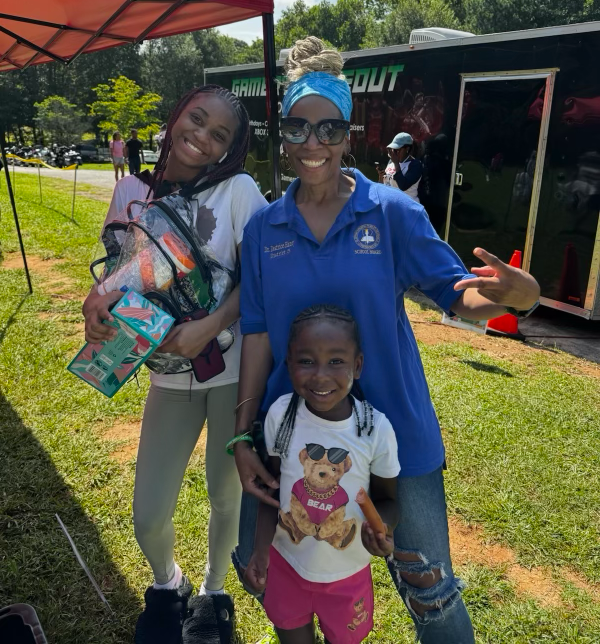
In the crowded gymnasiums, on the sidelines at football games, inside elementary school cafeterias, and at the countless school events that fill the rhythm of public education in Clayton County, one thing about Dr. Deatrice “Dr. D” Haney becomes clear before she ever begins explaining policy, budgets, or board governance: she does not move through the district like a distant elected official who is simply making an appearance; she shows up as someone who genuinely enjoys being near children, listening to them, laughing with them, encouraging them, and reminding them, sometimes without saying it directly, that the adults in the room are supposed to be paying attention.
Sometimes, the students do not even know who she is, which seems to amuse her more than it bothers her, because for Haney, the work has never been about the title, the seat, or the public recognition that can come with elected office.
“They’ll ask me, ‘What do you do?’” Haney said with a smile. “And I tell them, you know that seat you sit in at school? That food you eat at lunch? That’s what I help make sure you have.”
It is a simple explanation, but it carries the core of how Haney understands her role on the Clayton County Board of Education, because to her, the work is not rooted in public visibility as much as it is rooted in responsibility, and that responsibility means helping create the conditions that allow children to learn, grow, feel supported, and move through the school system with the resources they need.
For Haney, that mission did not begin with a campaign sign, a board seat, or an election night victory; it began long before she ever considered public office.
A Foundation Built on Service
Haney often traces her sense of service back to her childhood, where faith, family, and community responsibility were not treated as separate ideas but as part of the same expectation for how a person was supposed to move through the world.
“I’m a child of a grandmother who believed in Sunday school,” she said. “My parents were involved in Sunday school too. So serving children just became a natural flow.”
That early foundation eventually led Haney into volunteer work with Grady Health System in Atlanta, where she worked with first-time mothers who were often labeled by society as “at risk,” a phrase she does not accept easily because, in her view, the label places too much weight on the child and not enough attention on the systems, supports, and circumstances surrounding that child.
“No child is at risk,” she said. “It’s simply about how they were brought up and what support systems exist.”
Those experiences, combined with the influence of her grandmother and the relationships she shared with nieces, nephews, and young people in her own family, shaped the way Haney came to understand education, community, and public responsibility, because before she ever served on a school board, she had already learned that children do not succeed in isolation; they succeed when adults, families, institutions, and communities take their roles seriously.
Eventually, that understanding led her toward public office.
The Long Road to the School Board
Haney first ran for the Clayton County Board of Education in 2016, and she did not win.
For some candidates, a first loss becomes the moment that quietly ends the pursuit, but for Haney, that loss became something different; it became a test of conviction, patience, and clarity about why she wanted to serve in the first place.
“Some people pull back after they lose,” she said. “But I kept going. It wasn’t about the photos, the spotlight, or the flexing. None of that meant anything to me. It was always about the children.”
Four years later, she ran again, but this time, the campaign unfolded during one of the most uncertain periods in modern history, as the early days of the COVID-19 pandemic changed nearly everything about how candidates could reach voters, how communities gathered, and how people made decisions about who they trusted to represent them.
Door-to-door outreach stopped, public events disappeared, and even ordinary conversations became complicated by fear, distance, and the need to protect vulnerable residents.
“My base was senior citizens,” Haney explained. “And they weren’t opening their doors during COVID.”
So Haney adapted, using leftover campaign materials from her earlier run, leaning on word-of-mouth, depending on established community relationships, and finding creative ways to remain visible in a moment when the traditional path to voters had been disrupted almost overnight.
Technology, which had not been the center of her first campaign, became an unexpected tool in helping her connect with people, and after challenges to an opponent’s eligibility were resolved, Haney won the seat in 2020.
She has been serving ever since.
The Weight of Public Decisions
Serving on a school board involves far more than ceremonial appearances, school visits, or graduation photos, because behind every public-facing moment are decisions about money, staffing, policy, facilities, student needs, employee concerns, and the long-term direction of a school district that touches nearly every part of community life.
For Haney, the most difficult moments come when decisions must balance limited resources against real human needs, especially when board members are called to make choices that will affect employees, families, classrooms, and taxpayers at the same time.
“You’re never going to make everyone happy,” she said. “Especially when it comes to budgets.”
One example came during a period when teachers across Georgia were facing financial pressure and many districts were trying to determine how to retain educators while managing budgets that could not stretch in every direction at once.
For Haney, those are the moments that require more than a public vote; they require private reflection.
“I have to go home and ask myself: did I make the right decision?” she said. “Not the politically convenient one, but the right one.”
That distinction matters to her because school board service is not simply about having an opinion; it is about understanding the weight of the vote, the limits of the role, and the reality that every major decision requires collaboration with eight other board members who may see the same issue from different angles.
“I can give my opinion and my rationale,” Haney said. “But it takes eight other votes to move something forward.”
That reality, she says, requires patience, listening, and the willingness to let some decisions “marinate” before action is taken, because public education is too important to be governed by impulse, personality, or the pressure of the moment.
Serving an Entire Community
For Haney, representing District 5 means serving more than parents with children currently enrolled in Clayton County Public Schools, because the school system belongs to a much wider community that includes homeowners, business owners, retirees, grandparents, graduates, future families, and residents whose connection to the district may be financial, civic, or deeply personal.
Her constituents, she says, range from teenagers to senior citizens, and she is especially clear about the people who helped build the foundation of her public support.
“The seniors are my foundation,” she said.
She laughs when describing two of her most attentive constituents, Ms. Eloise and Mr. Terry, who follow her social media posts closely and make sure she remains accountable, not in an abstract political sense, but in the very direct way that community elders often do when they are watching someone they believe has a responsibility to represent them well.
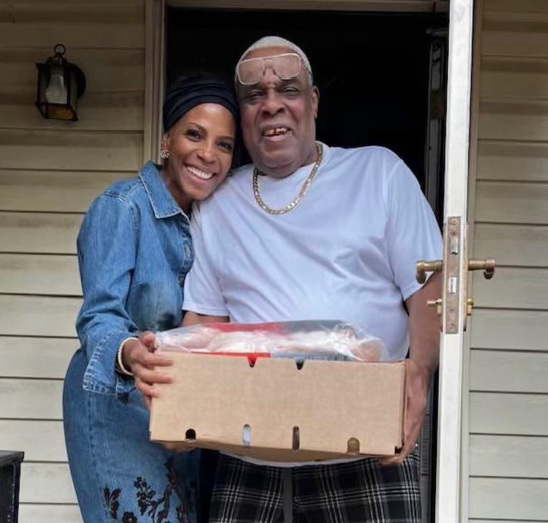
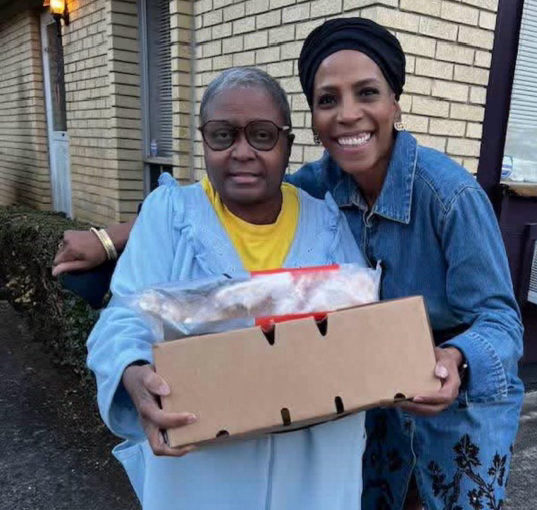
“They’ll call me if something looks crazy,” she said.
Even residents without children in the district have a stake in public education, because schools influence property values, workforce development, neighborhood stability, civic pride, and the overall strength of a community that depends on each generation being prepared for the next stage of life.
At the same time, Haney works to maintain strong relationships within the school system itself, describing her relationship with the superintendent and district staff as collaborative rather than hierarchical, because although the board has a governing role, she believes effective leadership still requires mutual respect.
“I respect them at all costs,” she said. “Though the board governs the superintendent, we’re still a team.”
The Energy of Students
If budget meetings and policy discussions represent the weight of school board service, time spent with students represents the reward, and for Haney, those moments are not side duties; they are the reminders that keep the work connected to its purpose.
She attends football games, elementary school competitions, graduations, and school events across the district, often showing up simply to support the students and to be present in the spaces where they are learning, competing, performing, and becoming.
Recently, she attended an elementary school championship event and found herself surrounded by energetic young competitors and parents who were every bit as invested as the students.
“The little ones were getting down,” she laughed. “And the parents were just as real about it.”
Those moments reinforce why she pursued the role in the first place, because when Haney is around students, the work moves from policy back into human form.
At graduation ceremonies, she is often one of the most enthusiastic people in the room, watching students cross the stage and thinking about everything they may have carried, survived, overcome, or quietly pushed through to reach that moment.
“I look at those students walking across the stage and think about what they’ve been through,” she said. “So I celebrate them—even when they’re frowning. I make them smile.”
She often reminds graduates that the ceremony is not just an ending, but the beginning of a different kind of responsibility.
“This is the real deal now,” she tells them.
Finding Her Voice
Those who knew Haney during her first campaign remember someone quieter and more reserved, someone still learning how to occupy public space, speak with authority, and trust that her voice belonged in rooms where decisions were being made.
Today, she laughs at that earlier version of herself, not with embarrassment, but with the perspective of someone who understands that leadership often reveals parts of a person that were always present but not yet fully called forward.
“My mom told me it was always in me,” she said. “I just needed to be in the right environment.”
Working closely with students, parents, seniors, and community members helped unlock that energy, giving Haney the kind of grounding that comes when a person realizes the work is not about performing leadership, but about being present enough to serve.
“When I’m around those students, it’s a whole different energy,” she said.
Staying Grounded
Despite the responsibilities of public office, Haney says she works hard to remain grounded, and much of that grounding comes from the people who shaped her before the public ever knew her name.
Her maternal grandmother remains one of her strongest influences, and her family continues to serve as a reminder of who she is outside the position, outside the meetings, outside the votes, and outside the moments when people see her in an official role.
“Without them, there would be no D,” she said.
She even jokes that her grandmother would hold her accountable if public recognition ever went to her head.
“I always say my grandmother would come up out of Lincoln Cemetery and knock me upside the head if I got cocky.”
The humor carries a serious message, because for Haney, humility is not a decorative value; it is part of how she measures whether she is still close to the reason she began this work.
At the end of the day, she does not see herself first as an elected official, a public figure, or a political personality, but as a woman shaped by family, faith, service, community, and the steady belief that children deserve adults who will take their futures seriously.
“I’m just D. Haney from Cascade in southwest Atlanta,” she said, “who made her way to Clayton County.”
And for the students she serves, that grounded perspective may be exactly what they need.