
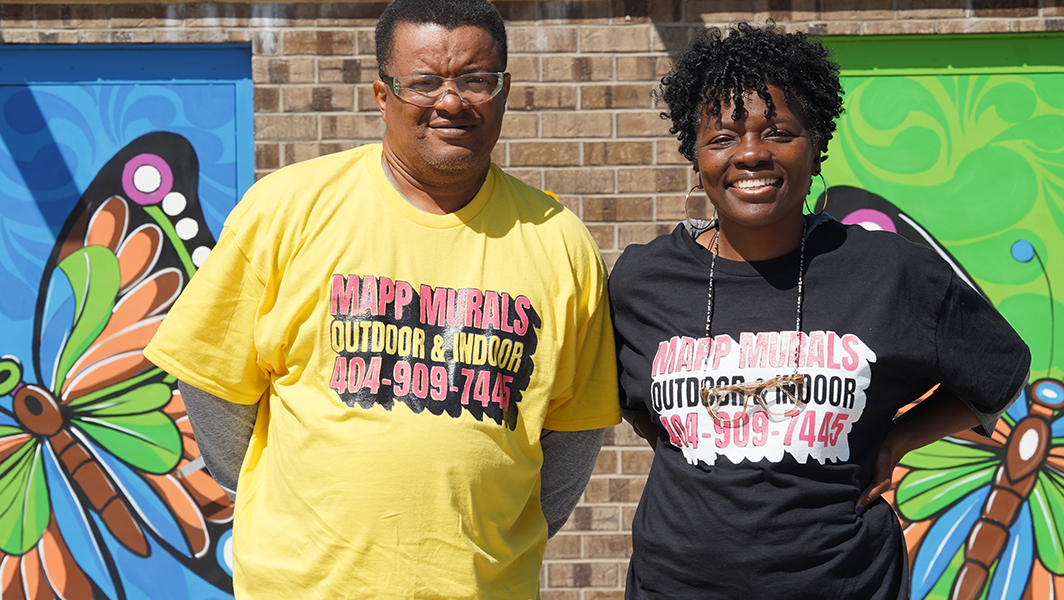
There is something fundamentally different about standing in front of a mural while it is still being created, as opposed to encountering it once it has already been completed, photographed, shared, and absorbed into the visual identity of a place, because in that unfinished state, before the final layers are sealed and before the public begins to interact with it, you are not simply looking at art—you are witnessing decision-making, problem-solving, physical endurance, and years of accumulated skill being translated into something that will eventually appear effortless to everyone who did not see it happen.
That is the space I found myself in, standing in Jonesboro with Joey Johnson and Johnny Mapp, watching a mural take shape while bees circled casually in the air, drawn to the color, completely uninterested in the human effort unfolding beneath them, which in many ways felt appropriate, because the work itself does not pause to announce its importance—it simply continues, layer by layer, until it becomes something people recognize as part of their environment.
Joey is not just an artist in this context; she is someone who shaped my own understanding of design at the beginning of my career, my first graphic design mentor, the person who introduced me to the discipline behind creativity, while Johnny, who I had long known as a photographer, reveals himself here in a different dimension entirely—as a muralist, a builder of large-scale visual narratives that live in public space and carry meaning far beyond their surface.
And what becomes immediately clear, before any technical explanation is even offered, is that murals are not an extension of casual creativity—they are structured, deliberate, and deeply technical undertakings that require the same rigor as architecture, even though they are often perceived as spontaneous expressions of art.
The Structure Beneath the Surface
When most people look at a mural, they see color, scale, and composition, but what they do not see is the translation process that must occur before any paint ever touches the wall, because nothing about this work begins at full size, and nothing about it is improvised once execution starts.
Joey explains that everything begins with measurement, and not in a loose or interpretive way, but with exact dimensions that must be translated from real-world scale into a workable design format, meaning that a wall that exists as eight feet by eight feet in physical space must be broken down proportionally into inches within a design file, ensuring that every element created digitally will align precisely when it is expanded back onto the surface.
From there, the process mirrors what many would reco
gnize from traditional graphic design workflows, where the client’s preferences—colors, symbolic elements, personal features—are gathered and interpreted into visual concepts, which are then presented as mockups, refined through feedback, and finalized only when the direction is clear enough to move into execution, because once the work transitions from concept to wall, the margin for error narrows significantly.
What becomes important here is not just the creativity involved, but the discipline required to maintain proportion, alignment, and visual balance at a scale where even minor inconsistencies can become magnified, which is precisely why the next phase of the process—the grid—exists as a non-negotiable step.
The Grid as a System of Control
Johnny describes the grid in terms that immediately ground the concept in familiarity, comparing it to a tic-tac-toe board or even a
color-by-numbers system, but what he is really describing is a method of control that allows a two-dimensional design to be transferred onto a large surface without distortion, ensuring that what was approved on paper is exactly what appears on the wall.
Each square within the grid becomes a reference point, a contained space where a specific portion of the design is replicated, allowing the artists to maintain perspective and alignment across an otherwise overwhelming scale, which is particularly important when lettering, facial features, or detailed elements are involved, because those are the areas where inaccuracies become immediately visible.
This is not guesswork, and it is not intuition operating unchecked; it is a system that enables precision, and it is one of the clearest examples of how technical structure underpins what is often perceived as purely artistic expression.
Materials, Surfaces, and Permanence
Another layer of complexity that does not reveal itself to the casual observer is the relationship between the mural and the surface it occupies, because not all walls are created equal, and each material—whether concrete, wood, or metal—demands a different approach in terms of preparation, paint selection, and application.
The mural in Jonesboro, for example, sits on a metal door, which immediately changes the equation, requiring a specific type of acrylic paint, a primer to prepare the surface, and a layered approach that ensures the paint adheres properly and maintains its integrity over time.
Johnny makes it clear that without this level of attention, the work would not last, and this is where experience becomes critical, because understanding how materials interact is just as important as understanding how to draw or design, particularly when the goal is not just to create something visually compelling, but to create something that can withstand weather, time, and public exposure.
Scale as a Different Discipline
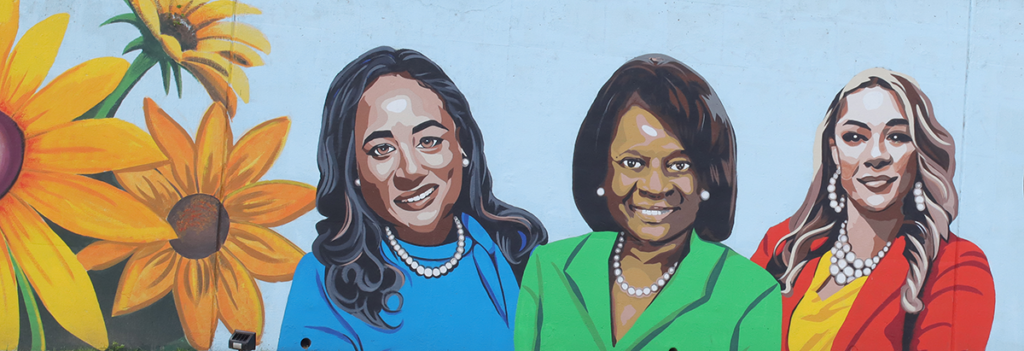
If the Jonesboro mural represents one level of complexity, the mural in College Park exists on an entirely different scale, stretching nearly 5,500 feet—close to an eighth of a mile—and requiring months of sustained effort, coordination, and physical endurance to complete.
What is striking is not just the size, but the method, because the entire mural is being painted by hand, without reliance on spray techniques that might accelerate the process, which means that every inch of that surface is the result of direct, manual application, a decision that reflects both a commitment to quality and an understanding of the visual depth that hand painting can achieve.
The timeline itself—beginning in November and extending through winter into spring—introduces another layer of challenge, because outdoor murals are typically executed in more favorable conditions, yet this project was driven by a larger purpose, tied to visibility, timing, and the role the mural will play in representing the area, particularly with its placement allowing it to be seen from incoming flights.
The Reality of Working Outside
There is a tendency to romanticize creative work, to imagine it as something fluid and inspired, but the reality of mural work, particularly outdoors, is that it is governed as much by environmental conditions as it is by artistic intention.
Cold temperatures that make it difficult to feel your hands, rain that can undo hours of work in a matter of minutes, and moisture within the wall itself that affects how paint behaves are all part of the equation, requiring constant monitoring of weather forecasts and adjustments to daily schedules, sometimes cutting work short to allow paint to cure properly before conditions change.
This is not a controlled studio environment; it is an open system where nature participates in the process, often unpredictably, and where resilience becomes just as important as skill.
The Artist’s Internal Process
Beyond the physical and technical challenges, there is also an internal process that unfolds during the creation of a mural, particularly when confronting elements that are more complex than anticipated, such as detailed hair textures or layered visual effects that must be built gradually rather than executed all at once.
Joey describes this as a tension between knowing that you have the ability to complete the work and not immediately seeing how all the pieces will come together, which requires a willingness to work in sections, to trust incremental progress, and to resist the urge to resolve the entire image mentally before it has been physically constructed.
It is in this space that doubt can emerge, but it is also where growth happens, because each completed section reinforces the process, eventually leading to a finished piece that often exceeds the initial expectation.
The Business of Being an Artist
While the work itself is demanding, the reality of sustaining a career in art introduces another set of challenges that are less visible but equally significant, particularly the need to continuously market oneself, build relationships, and remain visible in environments where opportunities can emerge unexpectedly.
Joey is direct in acknowledging that while the desire is to focus solely on creating, the necessity of promoting one’s work and communicating value to potential clients is unavoidable, even if it does not align naturally with the artist’s inclination.
Johnny reinforces this by emphasizing the role of networking, noting that many opportunities arise not from direct outreach, but from being present, from maintaining visibility, and from the accumulation of past connections that can resurface at critical moments, sometimes decades later.
What Makes It Worth It
For all of the complexity, the unpredictability, and the effort required, there is a clarity that emerges when both Joey and Johnny speak about what keeps them committed to this work, and it is not framed in terms of recognition or external validation, but in the ability to engage in their craft consistently, to build something tangible, and to experience the process of creation as both grounding and restorative.
Joey describes the act of painting as something that settles her, even on days when motivation is low, emphasizing that once the work begins, it creates a sense of alignment that reinforces why she continues to do it, while Johnny points to the broader impact, the ability to inspire others, particularly younger artists who encounter the work and begin to imagine their own potential within that space.
What Remains
What ultimately emerges from this conversation is an understanding that murals are not simply visual enhancements to a city, but are, in fact, markers of presence, effort, and continuity, existing as part of the public landscape in a way that invites interaction while simultaneously carrying the imprint of the people who created them.
Long after the process is complete, after the scaffolding is removed and the tools are packed away, the work remains, not just as an image, but as a point of connection, a place where people gather, take photographs, and engage with something that was once only an idea, translated through discipline and persistence into a shared experience.
And perhaps that is the most accurate way to understand what Joey Johnson and Johnny Mapp are doing—not simply creating art, but building something that allows a community to see itself, to interact with its environment, and to recognize, even if only briefly, the value of what has been placed in front of it.