



When people hear the title “Solicitor General,” they often imagine courtrooms, citations, and legal codes. What they rarely see is the human work behind local justice: correcting records that block employment, listening long enough for real needs to surface, and building cases that are fair to both victims and defendants.
In Clayton County, Solicitor General Charles Brooks, alongside Chief of Staff Kydra Finn and Chief Investigator Tommy Henderson, is advancing a clear idea: justice is not just a system of penalties. It is a public-service operation designed to reduce harm, improve outcomes, and tell the truth about a community that is too often misread.
The Case for Second Chances
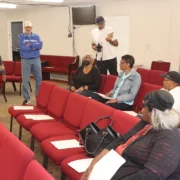
In July, the Solicitor General’s Office partnered with five of Clayton County’s seven municipalities to host a Record Restriction and Career Expo at Riverdale Town Center. The event looked like a job fair, operated like a legal clinic, and functioned as something closer to a reset.
“About 330 people attended,” Brooks said. “More than 100 had records restricted. Several received on-site interviews and job offers. We waived fees, pre-registered participants, ran full legal reviews with Georgia Justice, and walked petitions directly to the court for signature. The goal was simple: move people from paperwork to relief in a single day.”
In Georgia, what many people refer to as “expungement” is legally known as record restriction. The distinction matters. Record restriction does not erase history; it limits public access to qualifying records under state law. Misdemeanor arrests that did not result in conviction, cases that ended in acquittal, or charges that were never prosecuted may be eligible. In limited circumstances, individuals may also restrict up to two misdemeanor convictions over a lifetime.
“Public safety isn’t about optics,” Brooks said. “Stable work, housing, and access to education reduce repeat offenses. If a dismissed case from ten years ago still blocks a healthcare job, that’s not accountability—that’s friction.”
Chief Investigator Henderson sees the consequences daily. Background checks derail housing applications. Financial aid is denied over arrests that never became convictions. The toll is not only economic, but psychological.
“Victims deserve closure,” Henderson said. “Defendants deserve due process. Our job is to get both right.”

What Record Restriction Actually Means
Record restriction limits public access to certain criminal history entries when the law allows. It can remove barriers to employment, licensing, housing, and education. It is not automatic, not universal, and not available for violent felonies or ineligible offenses. The screening process is rigorous by design.
At the Riverdale expo, the office handled work residents usually face alone: pulling records, screening eligibility, drafting petitions, filing paperwork, and securing court orders. Employers then stepped in.
“Relief is only half the story,” Brooks said. “A job offer turns relief into momentum.”
Building Cases the Right Way
If the expo showed the office’s public-service side, the investigative unit shows its prosecutorial backbone. Henderson describes his team’s role as filling the space between arrest and verdict.
“Officers stop at probable cause,” he said. “We have to prove beyond a reasonable doubt. That gap is evidence.”
Investigators retrieve body-worn camera footage, 911 audio, surveillance video, certified convictions from other jurisdictions, and medical records with proper releases. Witnesses are re-interviewed when early statements are thin or inconsistent. Scenes are documented when initial responses miss key details. Every step is recorded so judges and juries can follow the logic.
“Precision, not punishment, is the goal,” Henderson said. “When the facts don’t support a charge, we say so. When they do, we present the evidence in a way that holds up.”
What Fairness Looks Like in Practice
For Brooks, fairness is not a slogan. It is a chain of decisions that must hold under pressure:
-
Charging what can be proven, not what pressures a plea
-
Offering diversion based on eligibility, not personality
-
Declining cases that lack legal elements
-
Communicating clearly with victims and honoring timelines
-
Owning mistakes quickly and correcting the record
“Break one link and trust snaps,” Brooks said.
Access Is Part of Justice
When Brooks took office, the public counter closed during lunch. For residents working shift jobs, that “small” policy was a real barrier. Today, the office stays open through the noon hour.
The team is also rewriting letters and forms into plain language, adding QR codes that link to checklists and next steps, and preparing a digital intake system to reduce delays and confusion.
“People remember how you treated them,” Finn said. “Even when the answer is no, clarity builds confidence.”
Measuring What Matters
The office tracks outcomes weekly, not for reports, but for course correction. Key measures include:
-
Time from citation to disposition
-
Diversion enrollment, completion, and re-offense rates
-
Record restriction approvals linked to employment outcomes
-
Victim service response times and satisfaction
-
Community outreach events and questions logged
“If we don’t measure, we’re guessing,” Brooks said. “And guessing isn’t improvement.”
From Clayton County to the Courthouse
Brooks arrived in Clayton County in third grade, attending Morrow Elementary, Babb Middle, and Forest Park High School. His family benefited from the once-stable manufacturing economy anchored by the Ford plant. He initially wanted to be an architect, later turning to law after an internship at the Clayton County District Attorney’s Office.
“I wanted to help shape the culture of the place that raised me,” he said.
That commitment shows in hiring as well. Most staff live in Clayton County by choice.
“Vested people protect standards,” Brooks said. “You feel every decision twice—as a professional and as a neighbor.”
Justice Is Local
Clayton County is a majority-minority community with a complicated history around policing and perception. Brooks does not avoid that reality.
“We have to tell our own story,” he said. “And we do that by modeling the culture we want—not marketing it.”
Courtrooms matter. But so do counters, clinics, conversations, and second chances.
“That’s the job,” Brooks said. “Not headlines. Outcomes.”
Clayton County’s story is complex, as is public safety. Brooks, Finn, and Henderson are not selling perfection. They are building competence, clarity, and access—one case, one clinic, one interaction at a time. If justice is local, this is what it looks like.