


A Life in Teaching, Dr. Jessie Goree has Influenced Thousands of People in Her Five Decades of Education
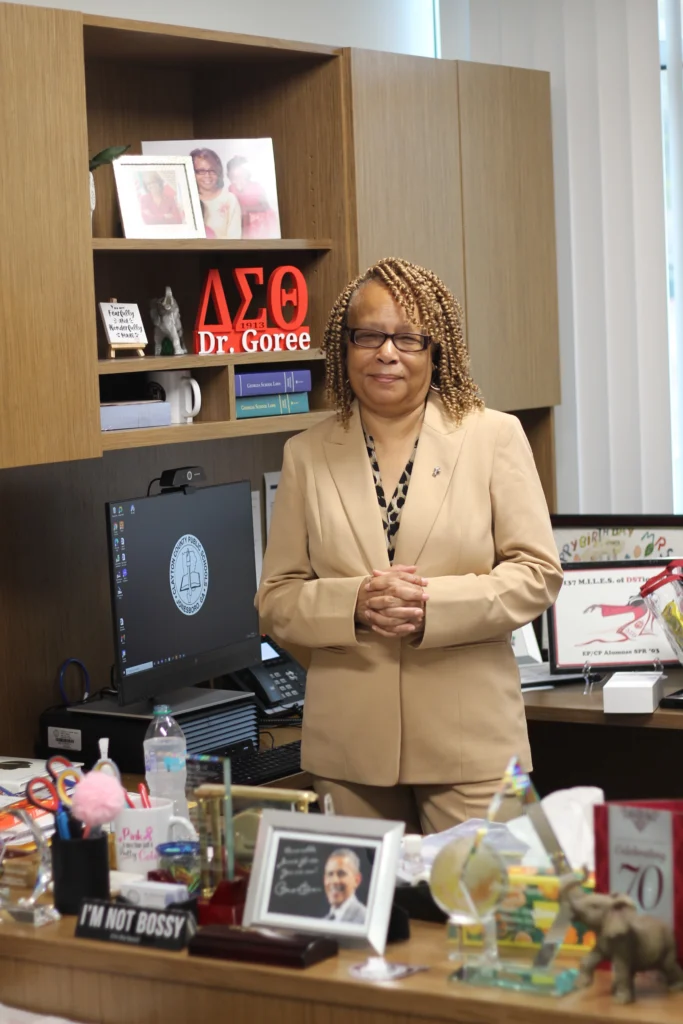
As with many of those who chose to become an educator, Doctor Jessie Goree was profoundly influenced by her first teacher, a Miss Reader, who taught first grade. After more than five decades of service to her community as a teacher and school board member, Goree can’t forget the woman who defined her career.
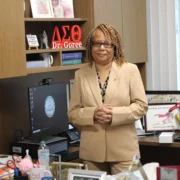
“She was the meanest, evilest person I think I ever met in my life,” Goree said in her office overflowing with photographs of her grandkids and awards she has collected over the years. “I just said, you know, when I grow up, I want to become a teacher but I don’t want to be like her. It was an inner goal to become an educator because I feel like without teachers no one really achieves anything.”
Growing up in the 1950s and 60s, there were not a lot of occupations open to women, especially minority women, Goree explained. “Maybe you’re going to be a preacher or maybe a teacher,” she said. Fortuitously, her teacher in high school, Miss Lauderdale, taught her the right way to teach using structure and understanding. Goree actually patterned her teaching style on this teacher, to the benefit of her many students over the years.
The current Chair of the Clayton County Board of Education, serving her fourth and final term, said that teaching is only the second most important occupation after parenting. “Because I feel like I make a difference in people’s lives,” she said. In addition to the students she has touched, Goree has left a legacy of attempting to make her students’ lives a lot better. She annually hosts and sponsors such events as College Fair, the Girls Conference, and the Male Involvement and Teen Summit. She came up with the idea for the Early Learning Center in in Riverdale, a literacy program that is trying to break the cycle of intergenerational poverty and literacy,
Being a Kentucky native, the game of basketball is a spiritual journey as well as a sport for Goree. So when she graduated college and looked for a teaching job, she only wanted to be in a city with an NBA team. At least the Atlanta Hawks, unknowingly, have contributed to the community by recruiting her to teach in the region for the next 31 years. Goree had several stops in the Atlanta Public School system, teaching math in both elementary and middle schools, before she decided to move to Clayton in 1999. “So I evaded the Atlanta teachers’ scandal,” she said with a sigh of relief.
Little did she know that another educational indignity would await her in Clayton County. She taught 8th grade math and became an instructional lead teacher for the next decade but then disaster struck. In 2008, the Southern Association of Colleges and Schools (SACS) revoked Clayton County schools’ accreditation citing general unethical behavior from the school board. Governor Sonny Perdue removed four board members and ordered a special election.
After the SACS decision, a photo of Goree sobbing next to Georgia State Representative Mike Glanton went viral. “Reporters from all over the world were on the property and they took pictures of it. I had someone from New York call me. He told me it even was in the newspaper in Hong Kong,” she said.
Because her son was set to graduate from North Clayton High School, Goree could not stand by and allow her son to have an unaccredited diploma. She ran for District 3 and won. Clayton County regained accreditation on probation in 2009 and worked to meet SACS’s demands.
“It took a lot of intensive board training. I would say like six months of just going here for a week and then we go there for a week,” she said of the work the board members were undertaking. “We were like under the microscope of the state and the national level.” The accreditation would be restored in 2016.
Goree believes the whole thing was politically motivated. Besides, she said, “Nobody even realizes that what accreditation is really just our paying money.” When the accreditation crisis was over, the first graduation was Riverdale High School where Goree. “cried the whole the whole time. I’m just sitting up there just crying and then my sons right away said, ‘I just want you to know I am so proud of the people that stuck with us because we lost a lot of kids because a lot of parents withdrew their children.’”
Just before this election time for the school board, Goree underwent a routine mammogram that revealed an early stage of breast cancer. She endured both chemo and radiation. In the midst of her treatment it was time for her to run for office again. The Teachers’ Union put up another candidate for Goree’s seat.
“I was probably at my physically weakened weakest point in my life. And I was out trying to campaign. I was very strong because so many times when you get a diagnosis like that you just say ‘I’m not gonna make it’ or whatever. I was totally the opposite,” she said. “It was my last day or the next the last day of radiation. I’m out there with my sign in the sun someplace I’m not supposed to be campaigning. But I ended up winning. It makes me appreciate every sunrise that I see every day.”
Nearing her end of almost 50 years in education, Goree is very happy that she is not coming up as a new teacher, whose salaries are so low they cannot afford to qualify to buy or even rent a decent place to live. In addition, students and parents today are much different than when she was a young teacher.
“I must say the great thing was that I was able to teach then because if it were now, I don’t think I would be in the classroom,” she said. “I’m just amazed that some of the problems that some of our kids have, and they’re just kids. They haven’t paid any bills yet. It’s really hard really hard being a child.”
With the literacy rate falling nationwide, Goree said today’s students are failing in the simplest ways. For example, when talking to supposedly well-informed students, Goree asked what the average body temperature is. None of them knew. One of them tried to Google the answer, and he was a kinesiology student at Clayton State.
At the monthly Board of Education meetings, when students are present, they are asked to do the Pledge of Allegiance. “They really don’t know the Pledge of Allegiance. They add words or it sounds like the star spangled banner,” she said. “It just seems like we lost a lot of the personal skills. I’m disappointed in the way that we are doing our children.” Goree is also concerned about parents and how they affect their kids. Many parents, who do show up for teacher-parent conferences, arrive in pajamas and bathrobes, with an extreme attitude. “That’s kind of like a normal. When my daughter was in school, I told her, if you act up and I have to come up to that school, I’m going to have my pink rollers in my hair. But now that type of stuff that would embarrass her, nowadays that’s how they come .”
Violence in the schools has been on the increase in recent years, she said. “It’s really sometimes not even safe to be in the classroom. Teachers are getting attacked.” Despite the setbacks, the disappointments, and the struggles, Goree is thankful for the years she spent teaching the adults of today. She still is in contact with many of them. She said they would reminisce about the classroom years. Her heart sings when she hears a former student say they remember how she cared and how she was patient with them. This is her last tenure on the Board. She wants to see her two granddaughters graduate before her term expires in 2028. Her solution to the present state of education her in Clayton County and the nation is very simple: “We don’t collectively understand the African proverb that it takes a village to raise a child.”