





Clayton County, Georgia—often recognized today for its diversity, role as a transportation hub, and proximity to Atlanta—sits on land shaped by centuries of conflict, struggle, and resilience. Beneath the highways, subdivisions, and commercial corridors lies a deeper history not only of railroads and growth, but also of displacement, enslavement, segregation, and systemic racism. To understand Clayton County fully, its past must be confronted honestly, because that past continues to shape its present.
Before Clayton: The Creek Homeland
Long before Clayton County was established in 1858, the land belonged to the Muskogean-speaking Creek Confederacy. For thousands of years, Creek families lived, farmed, and hunted along the Flint and South rivers. Archaeological evidence—including spear points, pottery fragments, and burial mounds—reveals thriving settlements dating back as far as 4000 BC.
This homeland was taken through treaties signed under coercion and deception. The most infamous was the Treaty of Indian Springs in 1821, which forced the Creek to cede vast territories, including land that would later become Clayton County. Many Creek leaders denounced the agreement as fraudulent, but the U.S. government enforced it regardless.
By the 1830s, the Indian Removal Act sealed the Creek people’s fate. Families were forced westward, often at gunpoint, along routes associated with the Trail of Tears. Thousands died from disease, starvation, and exhaustion. By the time Clayton County was founded, the original stewards of the land had been removed—physically displaced and largely erased from local memory. Farms, railroads, and plantations rose where Creek villages once stood, their stories buried beneath the soil.
Slavery and the Cotton Economy
Clayton County’s early economy was built on slavery. Cotton dominated the region, and enslaved Africans were the labor force that sustained it. Plantations spread across the county, their profits tied closely to the Macon & Western Railroad running through Jonesboro.
Enslaved men, women, and children cleared land, planted and harvested cotton, built infrastructure, and labored in households. They endured violence, family separation, and constant exploitation. Their labor generated wealth for white landowners and fed Georgia’s broader economy, yet their contributions were systematically excluded from official histories.
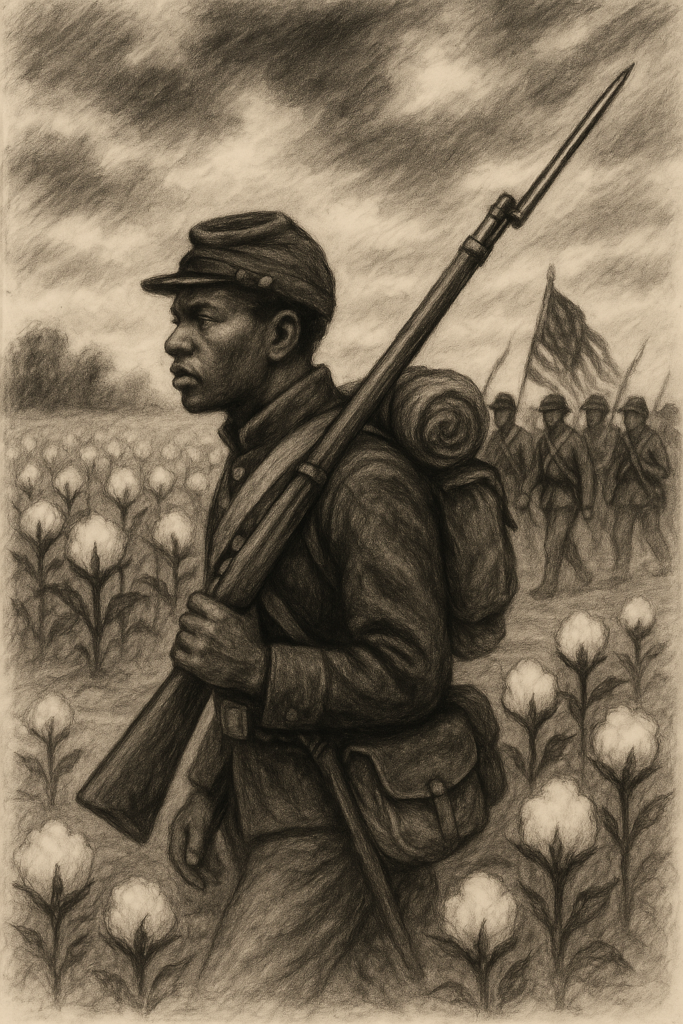
During the Civil War, Clayton County’s enslaved population lived amid upheaval. Some escaped to Union lines or aided the war effort when possible. Others remained trapped, forced to endure battles fought on the very land they had worked under bondage.
Civil War: The Battle That Doomed Atlanta
Clayton County became a pivotal site during the Atlanta Campaign of 1864, when Union General William T. Sherman targeted Atlanta’s railroads to cripple the Confederacy.
The Battle of Jonesborough, fought August 31 through September 1, 1864, proved decisive. Confederate forces under General William Hardee failed to repel the Union assault. When the railroad line was severed, Atlanta’s supply lifeline was cut. The city fell the following day, a turning point that bolstered Abraham Lincoln’s reelection and hastened the Confederacy’s defeat.
Nearby, the Battle of Lovejoy’s Station saw Union cavalry raids targeting Confederate supply depots and rail infrastructure. Although repairs were made quickly, momentum had shifted. Clayton County was left ravaged—homes burned, farms destroyed, and communities destabilized. For formerly enslaved people, the end of the war brought legal freedom, but little protection from the violence and discrimination that followed.
Reconstruction and the Rise of Jim Crow
After emancipation, many Black families remained in Clayton County, working as sharecroppers or tenant farmers. Though legally free, they were bound to the land through debt and exploitative contracts that kept them economically trapped.
Reconstruction briefly opened space for political participation, but by the late 19th century, Jim Crow laws enforced racial segregation across every aspect of life. Schools, transportation, housing, and public spaces were rigidly divided by race. Black residents were systematically denied the right to vote through poll taxes, literacy tests, and intimidation.
Violence reinforced this system. Lynchings and racial terror were a constant threat across Georgia, including in Clayton County. Fear became a tool of governance, shaping daily life for Black communities.
Segregation, White Flight, and Demographic Change
By the mid-20th century, Clayton County entered another period of upheaval. As desegregation orders reached local schools in the 1950s and 1960s, resistance was fierce. As integration advanced, many white families relocated to neighboring counties in what became known as “white flight,” taking investment and tax revenue with them.
Within a generation, Clayton County shifted from majority white to majority Black. That transition, however, was accompanied by underfunded schools, aging infrastructure, and a damaged public reputation fueled by media narratives of crime and decline.
In 2008, the county drew national attention when its school system lost accreditation due to governance and ethics failures—the first district in nearly four decades to face such a sanction. Although accreditation was restored, the stigma lingered, reflecting deeper patterns of disinvestment and inequality.
The Legacy of Racism Today
The legacies of displacement, slavery, and segregation continue to shape Clayton County in tangible ways.
Economic inequality persists, even as the county hosts Hartsfield–Jackson Atlanta International Airport, the world’s busiest airport. Clayton remains among the lower-income counties in metro Atlanta. Public perception often lags behind reality, with stereotypes portraying the county as unsafe or declining while overlooking its resilience and cultural vitality. Disparities in education, housing, healthcare, and environmental conditions mirror structures put in place generations ago.
Clayton County’s story is not simply one of growth and development. It is marked by exploitation, resistance, and survival. Facing these truths does not diminish the county’s identity—it strengthens it.
Triumph, Culture, and Community Power
Despite displacement and systemic racism, Clayton County’s Black community has continuously built, led, and reshaped the county’s identity. What survives here is not only memory of hardship, but evidence of achievement.
Black educators sustained schools through segregation and beyond. Parents, students, and community leaders were central to restoring the school system after the 2008 accreditation crisis. Clayton State University stands today as a symbol of academic access, research, and cultural growth in South Metro Atlanta.
Clayton has produced artists, athletes, and entrepreneurs whose influence reaches far beyond county lines. From nationally recognized musicians and professional athletes to local business owners, creativity and ambition thrive here. Murals, festivals, and grassroots arts initiatives fill public spaces, reflecting Black culture as a living force rather than a footnote.
Civic and Political Strength
Clayton County voters have played a significant role in shaping Georgia’s political landscape, including record turnout during the 2020 election. Locally, Black leadership now occupies central roles across government, from school boards and city councils to the county commission. This representation was hard-won and continues to reshape policy and priorities.
Black-owned businesses are expanding across sectors such as food, real estate, logistics, media, and technology. Combined with the county’s role as a global transportation gateway, Clayton is not merely enduring—it is innovating.
Closing Balance
Clayton County’s history is heavy with loss and injustice, but its present reflects resilience, creativity, and determination. To tell the story honestly means acknowledging displacement, enslavement, and segregation, while also amplifying the power of communities that transformed survival into progress.
Clayton County is more than its scars. It is proof that even on contested ground, people can plant roots, build culture, and shape a future that belongs to them.