

Arts Clayton has been here before—full rooms, busy calendars, kids rotating through classes, artists selling work off the walls, and families returning because the building felt like theirs. Founded in 1987, the organization has long served as a creative anchor in Clayton County. But when the pandemic hit, the arts were forced into survival mode. Buildings stayed closed. Programs paused. Revenue tightened. And the slow drain of “little things” became an existential threat.
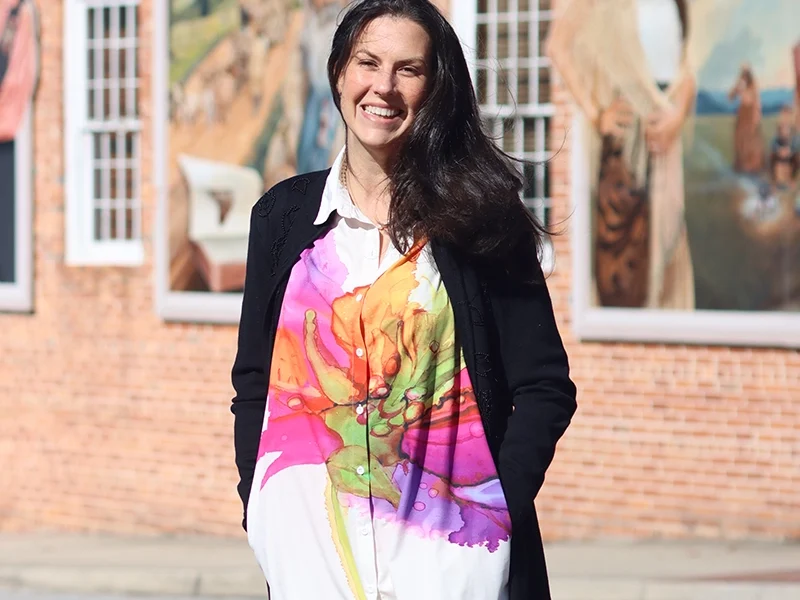
Today, Arts Clayton is rebuilding with intention. At the center of that effort is Kaysie Lazzaro, the organization’s Executive Director—first brought in as a short-term solution, now leading a long-term reinvention designed to outlast any one person.
“I always say I’m just a steward,” she said. “It’s been around since 1987. My role now is to make sure the little things that eat away at it aren’t a big problem—and that we have people and processes in place for checks and balances before it ever gets to that again.”
A New Orleans upbringing, a Clayton County calling
Kaysie is from New Orleans—born and raised. When she moved to Clayton County, the adjustment was real. She describes it as culture shock: fewer walkable activities, fewer obvious “third places” where families naturally gather. She didn’t immediately know where she fit. “I spent a lot of time trying to figure out what my role was going to be in this new environment,” she said.
What she did know was that her family loved the arts. Her husband is a makeup artist in TV and film. They met working in the film industry. Their daughters attend the Kay Pace School of the Arts—at an age where they’re already choosing art majors, a detail Kaysie calls both adorable and telling. She wanted opportunities that were local—close enough to be part of everyday life rather than a special trip. That desire to build what she couldn’t immediately find is a thread that runs through everything she does.
Before Arts Clayton, she was already working in the community—trying to “build community,” as she puts it—through creative thinking and development conversations tied to a separate effort: Harvest Village, a community development concept emerging around land off Walt Stephens Road. Her role leaned creative: imagining woodworking, glassblowing, knitting, pottery—ways a place could become a hub for making, learning, and gathering.
Around that same time, Arts Clayton was looking for an interim director. Board leaders Dr. Tim Hynes and Dr. Donna Jackson reached out with a practical ask: would Kaysie consider stepping in for 90 days while the organization continued its search? Kaysie said yes. That was about a year and a half ago.
From interim to institution-builder
The interim role didn’t stay interim for long. For Kaysie, what changed wasn’t ambition—it was evidence. She describes the first months as a steady stream of residents walking in and reacting emotionally to the reopening. “Do you want to know how many people came in those first six months and just cried that it was coming back?” she said. “That it wasn’t just shuttered.”
That response reframed the work. This wasn’t only a gallery. It was memory. Tradition. A community marker. A place people associated with the best parts of living here—classes, events, holiday markets, and the kind of shared experience that doesn’t translate through a screen.
She began reading older documents and learning the depth of what Arts Clayton used to be: a well-oiled machine through the 1980s, 1990s, and early 2000s. The question wasn’t whether to rebuild. The question was how.
Her answer is consistent: restore what worked, modernize what didn’t, and build a system that can hold under pressure.“I don’t even want it to revolve around me,” she said. “I want it to revolve around the building—what it does and what it becomes. Because if something happens with me, I don’t want the gallery to have to start over from scratch.”
What Arts Clayton does now
Arts Clayton operates as both a gallery and a program engine. It hosts roughly a show a month—twelve exhibitions a year—plus artist support, classes, youth programming, and partnerships with schools. One of the programs Kaysie pushed hard to restore
is the artist-in-residence model that places working artists in schools. That pipeline was disrupted after the pandemic: new principals, changed connections, a new reality. Re-establishing it meant rebuilding trust and access from scratch.
“We took the blueprint of what it was,” she said, “digested what was good to keep, what we needed to wait to expand on, and what had to be rebuilt.” There’s also a focus on professionalizing local artists—helping them price their work, understand value, and move beyond a mindset that treats art as sentimental storage.
“We realized early on that a lot of our artists have their art in their attic or spare room,” she said. “Most of them keep it because of sentimental reasons. We wanted to help them break free of that…that they can create as much as they want, that they don’t have to hold on to all of it. It’s in them.”
The model is accessible: artists can become members for $50 a year, which includes at least one show entry and opens the door to exhibiting and selling in the gallery.
And the building itself isn’t just for art on walls. Arts Clayton also rents event space—because it has to. Rentals help pay the basics: lights, water, staffing, the practical costs that keep a nonprofit alive between grants and donations. Funding, Kaysie says plainly, is the largest ongoing challenge. “Everyone loves the arts,” she said. “Everyone appreciates them. But nobody wants to pay us.”
The artist who didn’t claim the title
Kaysie speaks fluently about creativity—so fluently that people often assume she’s always been an artist. That’s part of what makes her next admission land. “If I ask how long you’ve been an artist…?” she repeated during the interview, pausing. “I technically only consider myself an artist for about four months now,” she said.
For years, she saw herself as the organizer—the note taker, the schedule keeper, the one behind the scenes. Her background in film reinforced that: she worked as a production assistant, building days toward the Directors Guild of America track, before choosing not to pursue directing.
“I wanted to enjoy my family and enjoy my life,” she said, noting the instability of the industry—strikes, negotiations, and now a growing tension around technology and AI. Her turning point came in an unexpected place: building a set for a local Vacation Bible School. The work came naturally. People praised what she made. They called her an artist—over and over—until the label finally stuck.
Her husband pressed the point. “You make things,” he told her. “You work with artists. You help them price their stuff and find their worth. Why don’t you see yours?” That moment mirrors her broader work at Arts Clayton: helping people claim what they are, then giving them structure to live it.
Culinary arts, agriculture, and a bigger definition of “creative”
During the pandemic, Kaysie and her husband discovered they’re tinkerers. A rare pepper gift became fermentation experiments. Experiments became hot sauces. Hot sauces became demand. Demand became a pepper and sauce business producing roughly 750 to 1,000 pounds of peppers a year.
As with most grassroots ventures, the idea hit a wall where passion meets regulation. Georgia’s rules around high-acid foods require production, processing, and storage to be housed in the same facility—an expensive barrier for small businesses trying to move from cottage-level sales to commercial scale. Co-packers weren’t an easy solution either; margins and supply chains complicate partnerships when the producer controls the key ingredient.
Instead of shrinking, Kaysie’s response is to think in infrastructure: creating a facility that supports multiple makers—not just her own business. A building that allows production, processing, storage, and distribution under one roof.
It ties back to her work in the arts because she doesn’t separate creativity from survival. “Culinary arts,” she said, naming it directly. “We work with schools with gardening programs and cooking programs.”
Her examples aren’t theoretical. She described a program at Kay Pace where students learned to make pasta from scratch—then ate what they made. She talked about teaching kids to extract oils from herbs like rosemary or calendula—skills that connect to products like lotions, candles, and tinctures. “If they can learn how to make goods they can sell,” she said, “we’re teaching a whole generation how to be self-sufficient.”
A bridge across the county
Ask Kaysie what she’s building, and she returns to community—specifically, community that connects across difference. She describes juried shows where people of different races, religions, ages, and backgrounds share space without having to perform sameness. They talk. They compare work. They compliment each other. They see each other.
She also talks about the power of beautification—how murals and public art can shift how a place feels, and how people behave inside it. “Just by giving people something beautiful to look at in their space,” she said, “it changes the feel. Our goal at Arts Clayton is to beautify Clayton County in every way that we can.”
The legacy: building something that can surpass her
When the conversation turns to legacy, Kaysie doesn’t describe a personal brand. She describes resilience. “I guess my legacy would be building this to where it could surpass me and not need me.”
It’s a sober kind of love—less about being known and more about making sure the doors stay open. It’s also a practical philosophy for a community institution: build systems, not dependency; build leadership pipelines, not single points of failure.
Arts Clayton is still a nonprofit. It still needs funding. It still relies on memberships, rentals, sponsors, and donations. But what Kaysie is doing is bigger than keeping the lights on. She’s rebuilding trust, reactivating programs, and restoring a civic space where creativity isn’t decoration—it’s a public service.
And she’s doing it with the mindset of someone steering a ship: not alone, but responsible for direction.
“It takes a whole crew,” she said. “I’m behind the wheel steering the ship—but there are so many people behind the scenes. If it wasn’t for the people who love this community, I don’t think any of it would be possible.”