
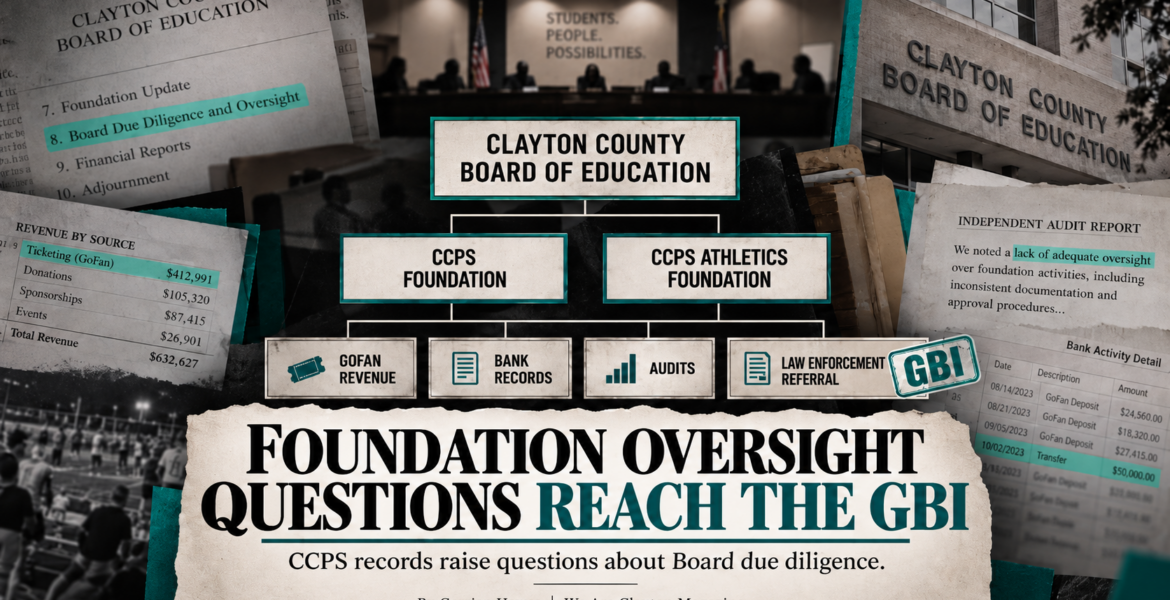
For more than a year, questions about the Clayton County Public Schools Foundation and a separate organization called the Clayton County Public Schools Athletics Foundation have moved through Board meetings, Foundation discussions, financial records and, eventually, an independent investigation commissioned on behalf of the school district.
The records reviewed by We Are Clayton Magazine do not establish that money was stolen from either organization, nor do they establish that every expenditure was improper. What they do establish is a pattern of weak financial controls, incomplete records, unclear authority and inconsistent explanations involving organizations operating in the name and ecosystem of Clayton County Public Schools.
They also raise a larger question for the Clayton County Board of Education: when Board members became aware of those problems, what due diligence followed?
That question matters because the Board was not dealing with an ordinary outside nonprofit that happened to support local schools. Both foundations carried the Clayton County Public Schools name, interacted with district employees and programs, and handled money connected to students, athletics, scholarships, donors and other school-system activities.
By the time CCPS commissioned an independent inquiry into the Athletics Foundation in 2026, investigators were still attempting to determine who authorized the organization, who controlled its finances, where certain revenue had been deposited and what records existed to document its spending.
The first warning signs involved the original Foundation
The Clayton County Public Schools Foundation, or CCPSF, was the district’s established philanthropic foundation and had a Board of Directors, officers and a formal governance structure. Its relationship with the school system was also significant enough that a December 2024 management memorandum prepared for the Board of Education stated that the Foundation’s Articles of Incorporation gave the Clayton County Board of Education “significant participation” in the administration of CCPSF.
By 2024, however, Foundation leadership was reporting that it did not possess complete historical financial records.
According to the December 2024 memorandum provided to the Board of Education, the Foundation’s accountants obtained bank statements and canceled checks and used those documents to reconstruct financial statements for 2022 and 2023. Even after that reconstruction, the memorandum said there remained a significant amount of revenue and expenditures that could not be categorized because the supporting financial records, operational records and meeting minutes were unavailable. Foundation leadership discussed obtaining additional documentation by October 15, 2024 so tax filings could be completed with better information, but the memorandum states that, to the author’s knowledge, the proposed meeting to obtain those records did not occur and the records were not produced.
Those circumstances did not prove that the unidentified transactions were improper. They did, however, put the Board of Education on notice that an organization closely tied to the school system was attempting to reconstruct years of financial activity without a complete set of underlying records.
That should have triggered a broader examination of financial oversight.
Instead, by the time those concerns were formally presented, another Foundation carrying the CCPS name had already been created.
A second Foundation operated without a board
The Clayton County Public Schools Athletics Foundation, or CCPSAF, was incorporated in November 2023 and became involved with elementary athletics.
Unlike the original Foundation, the Athletics Foundation did not have a Board of Directors.
That conclusion does not come from speculation or an outside critic. It comes directly from the April 15, 2026 independent inquiry commissioned on behalf of Clayton County Public Schools.
The investigator wrote that there was “no accountability or oversight of the CCPSAF operations” and found that no Board of Directors had been established. Lonnie Smith, who told investigators that he created the organization, acknowledged that a board had not been created, and other people interviewed said they knew of no governing board associated with CCPSAF.
The inquiry also found widespread confusion about the distinction between the Athletics Foundation, the original Foundation and CCPS itself. According to the report, employees at multiple levels said they did not know there were two separate foundations, while questions remained about why another organization had been created when the original Foundation already existed.
That confusion was especially significant because CCPSAF was not operating independently of the school system’s activities. The inquiry found that individuals associated with the organization were full-time CCPS employees, that elementary athletics was operated by district employees, and that school athletic events were held in district facilities.
Money generated by those activities was also being directed to the Athletics Foundation.
More than $158,000 went to CCPSAF
The GoFan records reviewed during the investigation documented $309,468 in elementary-athletics distributions between February 2023 and April 2025.
Of that total, $92,566 went to the original CCPS Foundation between February and December 2023, $158,110 went to the Athletics Foundation between January 2024 and February 2025, and $58,792 later went directly to CCPS Elementary Athletics after the district assumed control of the revenue.
The inquiry also reported that $180,382 in GoFan transactions had been changed from payment by check to payment by direct deposit into an account that district employees interviewed by the investigator could not identify. The report did not conclude that the $180,382 had been stolen or was missing. It concluded that Reed, Townsend and Harris did not know what bank account had received the direct deposits.
That distinction is important, but so is the underlying oversight problem.
An organization connected to a public-school athletic program had received more than $158,000 in documented gate revenue, and the district’s own investigator still needed to ask basic questions about the organization’s banking, authorization and financial controls more than a year later.
The issue is not simply that investigators did not immediately have every answer. The issue is that the structure had allowed those answers to become difficult to obtain in the first place.
The Board knew enough to order the Athletics Foundation shut down
The independent inquiry states that the Clayton County Board of Education requested that Lonnie Smith shut down the Athletics Foundation in approximately February 2025. The organization had been incorporated in November 2023, and the inquiry says it was not completely dissolved until April 2025.
That means the Board had reached the point of asking that the organization cease operations months before the independent inquiry was commissioned in 2026.
This is where the due-diligence question becomes difficult to avoid.
If the Board had concerns serious enough in early 2025 to request the shutdown of an organization that had been collecting school-related athletic revenue, what financial reconciliation was required at the time?
Were complete bank statements obtained? Were all deposits traced? Were all expenditures matched to invoices, purchase orders and receipts? Was the ending balance independently verified? Were the funds returned to the district reconciled against the Foundation’s total receipts and documented expenses? Was an audit performed before the organization was allowed to close?
The materials reviewed by We Are Clayton Magazine do not show that those questions were fully answered before the 2026 inquiry.
That does not mean no Board member ever asked them. It means the public record reviewed so far does not demonstrate a complete financial reconciliation following the Board’s request that the Foundation shut down.
There were already documented problems with financial records
The Athletics Foundation inquiry eventually found that official financial documentation remained incomplete.
According to the report, investigators and district personnel requested the bank name, bank account information, bank statements, receipts and purchase orders connected to CCPSAF. The report says that a self-created transaction spreadsheet was provided, but official banking documentation had not been produced to the investigator as of the completion of the report.
The investigator went beyond identifying that deficiency and recommended that CCPS consider financial audits of foundations associated with the district. The report stated that Board members, district employees and Foundation participants could not provide exact financial details about the organizations, that official banking records had not been provided concerning CCPSAF and possibly CCPSF, and that there had been no Board-of-Directors oversight of CCPSAF’s earnings and expenditures.
That recommendation is important because it moved the issue beyond whether one person had failed to produce a particular document. The investigator was identifying a broader governance weakness involving organizations associated with the school system.
The question then becomes what the Board did with that finding.
The original Foundation had warned the Board before the third-party investigation
Another reason this cannot be viewed solely as a 2026 problem is that the Board had already received concerns from the original Foundation.
The December 2024 memorandum described incomplete records involving CCPSF and separately raised concerns about the existence and activities of the Athletics Foundation. It also documented discussions involving scholarships, fundraising and donor relationships where questions had developed about which organization was receiving or controlling money.
A March 2024 meeting involving district and Foundation leadership was later memorialized with an agreement that CCPSF would serve as the school district’s “only philanthropic entity.” The same recap addressed the golf tournament and scholarship program and called for greater coordination between Foundation leadership and district personnel.
By then, however, CCPSAF already existed.
That creates a straightforward governance question. If district and Foundation leaders had agreed that CCPSF was the district’s only philanthropic entity, what review occurred to determine the legal and operational status of the separately incorporated Athletics Foundation?
The third-party inquiry would later find that even employees within CCPS often did not understand that there were two different foundations.
That was not a communications problem alone. When organizations use nearly identical school-system names while collecting money associated with students and school programs, confusion becomes a financial-control problem.
The accounts of who controlled the money did not agree
The independent inquiry also documented materially different descriptions of financial authority.
Lonnie Smith told investigators that Paul Scott monitored money coming into and going out of the Athletics Foundation and approved purchases and distributions, while Smith wrote the checks. Scott told investigators he did not know he had been listed as the Foundation’s chief financial officer, did not know the banking information and had no authority to write checks. Scott said Lonnie Smith handled the checks and that a request for bank statements produced a spreadsheet rather than an actual bank statement.
Gary Townsend likewise told investigators that he did not approve or sign documents related to the creation of the Athletics Foundation and did not know he was listed in the organization’s corporate records in the capacity reflected there.
Those conflicting accounts are important, but they should not be reduced to a question of who was telling the truth.
The larger problem is that basic financial authority should never depend upon recollection.
A properly governed organization should be able to produce its corporate resolutions, bank signature cards, account-access records, Board minutes, approval procedures, invoices, receipts and financial statements without relying on different people to remember who was responsible.
When those records are missing or incomplete, oversight has already broken down.
The questions eventually moved beyond the school district
By April 2026, the questions surrounding the Athletics Foundation were no longer being handled solely as an internal Clayton County Public Schools matter.
On April 23, eight days after the independent inquiry was completed, Interim Superintendent Dr. Douglas Hendrix sent the report to Clayton County District Attorney Tasha Mosley for consideration. His referral stated that, given the findings of the investigation, he felt obligated to forward the matter. The Georgia Secretary of State, Clayton County Police Department and Jonesboro Police Department were copied on the referral.
We Are Clayton Magazine has also been told by the Clayton County District Attorney that materials were subsequently provided to Clayton County Police and the Georgia Bureau of Investigation.
At this time, the records reviewed by this publication do not establish the status, scope or outcome of any GBI review or investigation.
That distinction matters. A referral to law enforcement is not a finding of criminal conduct, and an investigation does not establish guilt. What it does show is how far the questions had progressed by 2026.
The Board of Education had already requested that the Athletics Foundation be shut down approximately a year earlier. The district’s independent investigator later documented the absence of a governing board, incomplete financial documentation, uncertainty over bank deposits and conflicting accounts of who controlled the Foundation’s finances. The investigator recommended that CCPS consider financial audits of foundations associated with the school system.
By the time the matter reached outside law-enforcement agencies, the central oversight question was therefore no longer whether warning signs existed. The district’s own records show that they did.
The question was what had been done with them.
The third-party investigation created another due-diligence obligation
The April 2026 inquiry should have represented more than the end of an investigation. Its findings created a new responsibility for the Board and district leadership to determine whether every financial question had been resolved.
The inquiry did not simply identify past procedural weaknesses. It told the district that an organization connected to its employees, facilities and students had operated without a governing board, that its banking documentation was incomplete, that people listed as corporate officers disputed their roles, that substantial athletic revenue had moved through the organization and that exact financial details could not readily be provided by the people interviewed.
The report then recommended that CCPS consider financial audits of foundations associated with the district.
That recommendation matters because a third-party inquiry and a financial audit are not the same thing.
The inquiry reconstructed events through interviews, documents, emails and other records. A full financial reconciliation would answer a different set of questions: how much money entered each account, where each deposit originated, what expenditures cleared the account, what documentation supported those payments, what balance remained and where those remaining funds ultimately went.
In the records reviewed by We Are Clayton Magazine, we have not yet identified a completed forensic financial reconciliation of CCPSAF showing every dollar received, every expenditure made, the Foundation’s final balance and the disposition of remaining assets.
We also have not identified a public Board action establishing a comprehensive new oversight policy governing nonprofit organizations using the Clayton County Public Schools name or handling revenue connected to district activities.
Those records may exist, and if they do, they should be produced.
If they do not, that absence deserves an explanation.
The original Foundation and the Athletics Foundation presented different problems
It is important not to merge the two organizations into one allegation of wrongdoing because the records do not support that conclusion.
The original CCPS Foundation had a Board of Directors, formal leadership and an accounting structure, but its leadership reported significant difficulties obtaining historical records and reconstructing prior financial activity.
The Athletics Foundation presented a different problem. It had no governing board, unclear authorization, significant school-related revenue, conflicting descriptions of financial authority and missing official bank documentation at the time of the district inquiry.
Those were different governance failures, but they ultimately returned to the same institution: the Clayton County Board of Education.
The Board was responsible for governing the public school system around which both organizations operated. It received concerns about the original Foundation, later requested that the Athletics Foundation shut down, and ultimately received the findings of an independent inquiry documenting the lack of oversight within CCPSAF.
The due-diligence question is therefore not whether the Board eventually became aware of the problem.
The records establish that it did.
The question is whether the Board followed those warnings far enough.
Oversight cannot begin after the money becomes difficult to trace
This investigation has produced plenty of names, competing explanations and unresolved allegations, but concentrating only on individuals risks missing what the documents make increasingly obvious.
The system itself allowed the situation to develop.
One Foundation had a Board of Directors but later had to reconstruct historical finances because supporting records were incomplete. A second Foundation operated without a governing board while receiving more than $158,000 in documented elementary-athletics GoFan revenue. District employees were listed as corporate officers while some later told investigators they did not know the roles assigned to them. The district’s investigator could not obtain all of the banking documentation needed to fully reconstruct the Athletics Foundation’s finances, and the investigator ultimately recommended financial audits of foundations connected to CCPS.
The Board of Education eventually asked questions, requested that the Athletics Foundation be closed and received the findings of an outside inquiry.
The matter then moved beyond the district and, according to the Clayton County District Attorney, was provided to Clayton County Police and the Georgia Bureau of Investigation.
That progression matters because the purpose of oversight is not to wait until financial questions become serious enough to require outside investigators.
Oversight is supposed to make those questions answerable from the beginning.
For Clayton County residents, the question is no longer simply whether something improper happened inside one Foundation or another. The more consequential question is whether the people entrusted with governing the school system required enough documentation, enough financial transparency and enough institutional accountability to know.
The records reviewed so far show that, for significant periods of time, they did not have those answers.
Now the public needs to know what changed after they learned that they did not.