
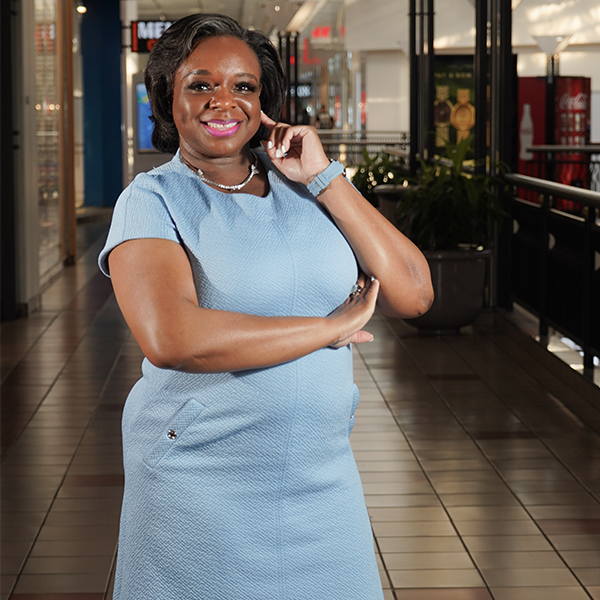
Through grief, business, public service, and economic development, Chivonne Noel Fleming has kept building, kept serving, and kept opening doors in Clayton County.
Some reunions are small and pleasant, little more than a chance to exchange updates and smile at how quickly time has passed. Others do something more powerful. They restore memory. They bring old conversations back to the surface. They remind you that the person sitting in front of you is not starting from nowhere, and neither are you. That was the feeling in reconnecting with Chivonne Noel Fleming, whose life over the last decade has moved through entrepreneurship, public service, political courage, motherhood, grief, and economic development, all while remaining deeply tied to Clayton County and the people who call it home.
What becomes clear in conversation with Fleming is that none of her work stands alone. The campaign trail is connected to family history. Business is connected to service. Economic development is connected to place. Grief is connected to purpose. Even the most practical turns in her story carry emotional weight, because she does not speak about work as a ladder or a performance. She speaks about it as responsibility, visibility, and impact.
A Campaign That Meant More Than a Seat
When Fleming ran for Clerk of Superior Court, she did so knowing both what the office meant and what it represented. She did not win, and she says that directly, without dressing it up, but she does not describe the campaign as a failure. Quite the opposite.
“It was amazing,” she said. “I did not secure my seat, but when I tell you the journey was rewarding. Met some amazing people, connected with the community like I’ve never connected before.”
That race carried special meaning because Fleming is a first-generation American whose roots stretch back to Jamaica through her father and Bermuda through her mother. For her, appearing on the ballot was not merely a personal milestone. It was something her whole family could claim.
“When I vote, I vote for my whole family,” she said. “So to be on the ballot, it was a huge win for my family.”
That statement lands because it reveals how she understands public life. Not as self-display, not as vanity, and not as abstraction, but as something inherited, carried, and made visible.
“When I vote, I vote for my whole family. So to be on the ballot, it was a huge win for my family.”
Family History, Fear, and the Weight of the Present
That family consciousness shaped even the most difficult parts of the conversation. When the subject turned to immigration and the fear surrounding ICE, Fleming did not answer from ideology alone. She answered from family memory.
“Well, again, as first-generation American, I think it’s absolutely horrible,” she said. “I thought we were the land of the free.”
Then she shared the story of her ninety-two-year-old aunt in Bermuda, who had spent years refusing to come to the United States because she feared deportation. At the time, relatives thought her concern was irrational. Looking back now, Fleming sees something else entirely.
“We thought that was ludicrous,” she said. “She was right.”
It is one thing to watch national debates unfold from a distance. It is another to hear them echo through your own family story. Fleming’s response was measured, but it carried the force of someone who understands that policy is never just policy when it reaches into the lives of real people.
Why She Ran
Her decision to run for clerk did not emerge from ambition for ambition’s sake. It came from experience, pain, and firsthand exposure to systems that do not always serve people well.
“As someone that has experienced a significant amount of loss, I have been through the court systems on a lot of different levels,” Fleming explained. “I saw firsthand from a consumer, changes that needed to happen. And so I wanted to be the change I wanted to see.”
She also brought practical knowledge to the race. Fleming had worked in the City of Atlanta clerk’s office, giving her direct understanding of what the role requires day to day. That combination of lived experience and administrative experience gave her campaign its shape. She was not guessing at the work. She knew the machinery, and she knew the human cost when that machinery falls short.
Building Spaces for Women, Then Learning How to Pivot
Long before her recent campaign, many people in Clayton County knew Fleming through her entrepreneurial work. One of the most memorable chapters was Blue Boutique, a business she remembers as much more than a storefront.
“I was able to create a safe space, a happy space, a cute and quaint space on the south side of Atlanta for women to come, whether it was to relax, have a glass of wine, kick back, shop, and just live their best life,” she said. “We would have prayer night once a month. We would do sip and paints. We’ve done so many things there together.”
The boutique was deeply personal. She opened it on her late husband’s birthday and dedicated it to him. When that chapter ended, she held on to the business inventory, unsure at first where it might lead, only to find that when the pandemic shut the world down, the boutique could still serve her through online sales and virtual engagement. That detail matters because it reveals a pattern that has repeated throughout her life: when a chapter closes, she does not collapse into it. She studies what remains and finds another way forward.
The Return of Chivonne Noel & Co.
That same pattern of reinvention is visible in her current consulting work. What once existed as Amazing Business Concepts has returned in a more expansive form as Chivonne Noel & Co.
“Previously under the umbrella, Amazing Business Concepts, where my slogan was, I made people’s business needs as easy as ABC,” she said. “And now here I am again, you know, a decade or so later. Chivonne Noel & Co. has rebirthed and rebranded and we’re back better than ever.”
The new company reflects broader reach and deeper authority. Fleming describes the work under that umbrella as “economic development,” “strategic planning,” “project management,” and “business startup and or shifting if your business is in need of a pivot.”
That range is not random. It comes from years of watching how businesses struggle, grow, stall, reposition, and survive. It also comes from her own professional evolution, especially the way she began to understand the deeper systems behind local growth.
Why Economic Development Became the Work
Fleming traces much of that development to her time subcontracting under Nickel Works Consulting and serving on the administrative team that helped open Clayton County’s first community improvement district. The work expanded the frame through which she saw business and place.
“That really intrigued my interest in economic development,” she said. “I used to say, and I would still say that I love real estate, but now I say I love economic development. I love all the pieces that go along with it.”
That distinction matters. Real estate can be transactional. Economic development requires a wider view. It asks who is building, who is benefiting, who is being left out, what spaces are being activated, and how community life is being shaped by the movement of money, land, and opportunity. Fleming speaks about it not like a buzzword, but like someone who has watched the pieces connect.
“I used to say that I love real estate, but now I say I love economic development. I love all the pieces that go along with it.”
Southlake Mall and a Full-Circle Return
Few places illustrate that more clearly than Southlake Mall, where Fleming’s story has come full circle. A Clayton County native, she first knew the mall as a child, then as a teenager working at Baker’s Shoe Store, and later as a professional serving in leadership there.
She described the path back to Southlake with the kind of detail that makes it sound almost ordained. “One day I was literally scrolling on Instagram and I found this job,” she said. She submitted her résumé on a Wednesday, interviewed that Friday, and before Monday morning had an offer letter with benefits and salary. “And I’ve been here ever since.”
What she found there was not simply a paycheck after loss, though that mattered. It was a role that allowed her to serve the county through a place that has long been part of its identity.
“Even though it’s a job for me, it’s serving my community,” she said. “I enjoy being able to open the doors for people.”
In an era when so many malls are spoken about in the past tense, Fleming offers a different account of Southlake. She notes that the mall is currently at full occupancy and remains a major retail anchor for the south side.
“We’re at 100% occupied,” she said. “We are thriving. We’re doing well.” She also points out that Southlake, built in 1976, is now marking fifty years and remains “the largest indoor retail space on the south side of Atlanta.”
That is not nostalgia speaking. It is current fact, spoken by someone positioned to know exactly what the property means and what it still produces.
The Convocation Center Effect
Fleming is also clear-eyed about what the Arena At Southlake could mean for the area surrounding the mall. She is not speaking in hypotheticals. She has already seen the impact.
“My tenants have reaped the benefits already,” she said. “Those babies came and shopped. Whether it was to buy lunch, a trinket, whatever it is, they stimulated our economy. And we’re grateful.”
It is a simple statement, but it captures something larger. Public infrastructure does not exist in isolation. Schools, venues, shopping centers, transportation corridors, and civic investment all affect one another. Fleming understands that interplay not from theory, but from direct observation and daily work.
A New Role, Same Commitment
As of March, Fleming’s role at Southlake shifted. She transitioned from assistant general manager into an independent contractor working on a project basis, with the mall becoming the largest client of Chivonne Noel & Co.
“This is still my home,” she said, “but it also is the largest client that I have under Chivonne Noel & Co.”
Her work now includes collections, leasing, and broader strategic business support, but she speaks most passionately about what happens when small businesses get the chance to move from private hustle into public visibility.
“I’ve had the opportunity to bring small businesses from out of their home into the mall,” she said. “A lot of times it’s been life changing for them.” She recalled watching business owners move into spaces near national brands and later return overwhelmed with gratitude. “I’ve had tenants come up to me a month after, six months after, a year in tears. Thank you for the opportunity. And it’s been my honor, my absolute pleasure.”
That may be the clearest expression of who she is professionally. She does not talk about placement as occupancy alone. She talks about it as transformation.
“I’ve had the opportunity to bring small businesses from out of their home into the mall. A lot of times it’s been life changing for them.”
Grief, Love, and the Reason She Keeps Going
No honest portrait of Fleming would leave out the role of grief in shaping her life and work. She speaks of her late husband not as someone whose memory sits quietly in the background, but as a continuing source of force.
“He’s a big part of my why,” she said. “He was my biggest cheerleader.”
She described a kind of support that many people long for but few truly receive. If she came home with a new idea, however unlikely or unconventional, he did not diminish it. He backed it.
“I could come home and say, you know what, I want to do basket weaving,” she said, laughing, “and my husband was coming home with baskets and whatever I needed.”
That support enlarged her own sense of possibility. It helped create the woman who could launch businesses, write books, run for office, and reimagine her future after devastating loss.
In one of the most moving reflections of the conversation, Fleming explained how even her campaign became part of her grief journey.
“When I ran for office, that was a part of my grief journey,” she said. “To have my whole community shouting vote for Fleming, of course that’s my surname, and so I felt like they were voting for him too.”
That is not a small statement. It reveals the depth of the connection between love, name, public life, and remembrance. For Fleming, the campaign was never just political. It was also personal testimony.
Motherhood Without Disappearing
She speaks about her son with the same mixture of honesty and feeling. As he prepares to graduate, she describes herself as both proud and heartbroken by how quickly time has moved.
“I’m so proud and sad,” she said. “I can’t believe I got a grown baby.”
Later, she explained that one of her clearest priorities in returning to more traditional work was finding a structure that would not consume her at the expense of motherhood.
“My son has never experienced mom can’t be there because I have to work,” she said. “I wanted to still be a hands-on full-time mom.”
That matters because it reveals the principles beneath her decisions. She did not want survival to erase presence. She did not want responsibility to require disappearance. She wanted to provide and remain available. In that, as in so much else, she was building against a script many women are told they have no choice but to accept.
“It’s the People for Me”
Fleming’s civic résumé is substantial. She has served as immediate past president of the Clayton County Federation of Democratic Women, served Clayton County at the state committee level for the Democratic Party, and completed a term as secretary of the Library Board of Trustees. Yet when she speaks about value, she returns not to title but to people.
“It’s the people for me,” she said. “I can be almost anywhere and people will stop me and share with me something that inspired them. And that is priceless.”
That line explains a great deal. It explains why she has remained visible across so many sectors without sounding self-congratulatory. It explains why service appears in her story not as branding, but as habit. It explains why, after all these years, the impression she leaves is not one of performance, but of substance.
You Are the Village
At one point in the conversation, after reflecting on years of reciprocal support, mentorship, and presence, she was told something simple and true: “You are the village.”
The line stayed because it fits. Chivonne Noel Fleming has been the woman helping people organize their businesses, helping small entrepreneurs step into visibility, helping institutions function more humanly, helping community spaces remain useful, and helping others feel supported in seasons when support was not guaranteed. She has been the encourager, the connector, the strategist, the person making room.
And that may be the clearest way to understand her now. Not merely as a former candidate, not merely as an entrepreneur, not merely as a consultant or civic leader, but as a woman who has made a life out of showing up with substance. She has moved through Clayton County in many roles, but the thread running through all of them is steady: she builds, she serves, she remembers, and she opens doors.
In a time when community is often reduced to slogan, Chivonne Noel Fleming continues to practice it as labor, presence, and proof.