
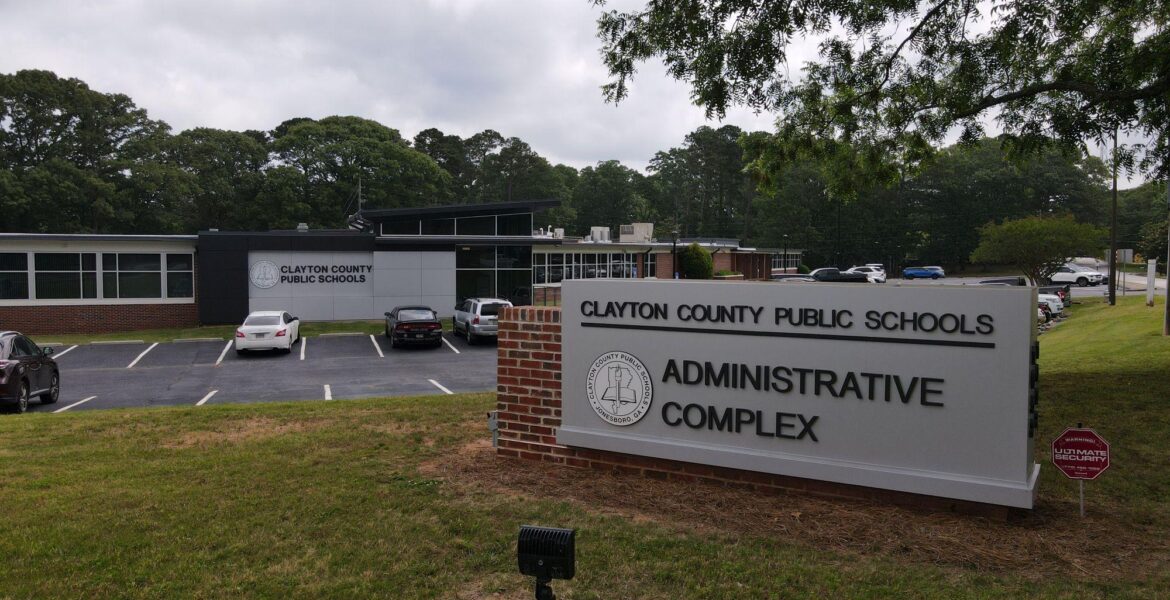
Dr. Douglas Hendrix Sr. is leading Clayton County Public Schools under a one-year contract with full superintendent authority. The Board discussed personnel matters privately before appointing him, but the records still do not show how—or when—the position will become permanent.
Clayton County Public Schools is not operating without leadership. Dr. Douglas Hendrix Sr. has served as interim superintendent since February 2, 2026, under a one-year contract that gives him the broad authority normally associated with the superintendent’s office. He is responsible for administering the district, supervising personnel, preparing the budget, recommending organizational changes and carrying out Board policy. What the district does not have—at least in the records provided to We Are Clayton Magazine—is a documented process explaining how the Board of Education intends to move from interim leadership to a permanent appointment.
The distinction is important. Hendrix is doing the work of the superintendent, and many residents, parents, former students and district employees believe he is doing it well. The unanswered question is not whether Clayton County has someone functioning in the position. It is whether Hendrix is serving as a temporary leader while the Board prepares for a search, whether he is being evaluated as a permanent candidate or whether the Board already views him as the likely permanent superintendent but has not yet taken formal action.
The transition and the closed-door discussion
The transition began publicly during the January 12, 2026, Board of Education meeting, but the Board first met in executive session. An affidavit signed by Board members and notarized after the meeting certifies that the closed session included personnel, land and legal matters. The personnel category permits discussion of the appointment, employment, compensation, hiring, discipline or dismissal of a public employee or officer. That means the Board had a lawful opportunity to privately discuss Dr. Anthony Smith’s departure, Hendrix’s appointment, contract terms or related personnel matters before taking action in public.
The affidavit does not disclose what Board members said, whether other candidates were discussed, whether Hendrix was considered for the permanent job or whether the Board talked about conducting or delaying a search. It identifies only the legal categories discussed during the closed session. It would therefore be inaccurate to say the Board never discussed the leadership transition. The more precise finding is that the substance of those private discussions is not disclosed, and the records produced later contain no written permanent-search plan or timetable.
After returning to the public meeting, the Board voted to accept the separation agreement and retirement of former Superintendent Dr. Anthony W. Smith. That motion passed with five votes in favor and four abstentions. The Board then unanimously appointed Hendrix as interim superintendent, effective February 2. All nine Board members supported his appointment. The public minutes document both decisions but contain no discussion of a permanent superintendent search, no proposed timeline and no description of what the Board expected to happen after Hendrix entered the position.
An interim contract with full authority
Hendrix’s contract runs through February 2, 2027. Although the agreement repeatedly identifies him as interim superintendent, it does not restrict him to basic caretaker responsibilities. He is given broad authority over district administration, personnel, financial planning, policy implementation and organizational leadership. His annual salary is $315,000, and he receives an additional $1,000 monthly administrative supplement, bringing his listed annual cash compensation to approximately $327,000 before benefits and reimbursements. Either Hendrix or the Board may terminate the agreement for any reason with 30 days’ written notice.
The contract creates operational continuity, but it does not establish a permanent-selection process. It does not require the Board to begin a search by a certain date, identify other candidates or vote on Hendrix before the agreement expires. It requires an annual evaluation, but the records provided to WACM do not identify the standards the Board will use to determine whether Hendrix should remain in the position permanently.
What the district produced—and what it did not
South Atlanta Media, publisher of We Are Clayton Magazine, submitted an open-records request seeking documents related to Hendrix’s appointment and the permanent superintendent process. The request included his contract and compensation, Board minutes and votes, written succession plans, search timelines, candidate qualifications, selection criteria, search-firm proposals, search expenses, relevant Board communications and records of public or stakeholder participation.
Clayton County Public Schools responded on July 23. The district produced Hendrix’s contract, the January 12 meeting minutes and the executive-session affidavit. For the remaining categories—including permanent-search planning, candidate criteria, search-firm agreements, search costs, written communications and public-engagement records—the district responded: “No responsive documents.” The district’s custodian of records separately certified that the documents provided were true and correct copies maintained by the school system in the ordinary course of business.
That response does not prove Board members have never discussed the superintendent position. The affidavit confirms that personnel matters were discussed privately on January 12, and additional conversations may have occurred verbally or in later executive sessions. What the response does establish is that the district produced no written records showing that a permanent search had been formally planned, initiated, funded or delayed. It also produced no written framework explaining whether Hendrix is being evaluated against other candidates or what measures will determine whether he receives a permanent contract.
Tellis supports moving forward with Hendrix
During an interview with WACM, Board member Joy Tellis Cooper made clear that she is prepared to move forward with Hendrix. “For the record, I am ready to move forward with who has displayed that they not only deserve the job, they’re committed to the job,” Tellis said.
Tellis described Hendrix as a longtime Clayton County educator who began as a teacher and advanced through the district’s leadership structure. She said his experience and familiarity with the community allow him to understand the students, employees and families affected by district decisions. “He started from being a teacher and moved up through the ranks,” she said. “So the community knows him. He knows the community.”
Tellis also questioned whether an expensive external search would be a responsible use of taxpayer money when the district already has an experienced leader performing the job.
“Searches cost thousands and thousands of dollars,” she said. “If there is an effective leader there, why would we go out and waste additional taxpayers’ money?”
That is a legitimate position. The Board may determine that Hendrix’s experience, current performance and knowledge of Clayton County make a national search unnecessary. But choosing not to conduct a search is still a decision that should be stated publicly. The Board could evaluate Hendrix, publish the standards it will use and vote on a permanent contract without hiring an outside firm. The missing element is not necessarily a national search. It is a clearly explained process.
Community support is strong, but the process remains disputed
Comments collected across Facebook, TikTok and Nextdoor show considerable support for Hendrix. Residents described him as doing an “awesome job,” called him “the only choice” and said they hoped he would receive the permanent position. A student liaison said Hendrix was doing a great job, while former teachers and former students praised his experience, character and history in the district. Those comments do not amount to a formal performance review, but they show that Hendrix has meaningful community support and that the public debate is not simply driven by opposition to him.
Other residents support Hendrix but still believe the Board should conduct an open process. They questioned why other candidates have not been interviewed and why the district has not announced a permanent search. Their position is not necessarily that Hendrix should be rejected. It is that a documented selection process would allow the Board to demonstrate why he is the strongest choice rather than allowing a temporary appointment to become permanent without clearly stated standards.
Several commenters also said they believed the Board was waiting for incoming members to take office before making the permanent appointment. They argued that newly elected members should participate in choosing the superintendent they will later oversee. That position may be reasonable, but the district did not produce a written resolution, timeline or communication confirming that the Board formally decided to delay the process for that reason. If waiting for new members is the plan, the Board could resolve much of the confusion by confirming it publicly and explaining when the decision will resume.
Some residents thought Hendrix was already permanent
The community comments also revealed uncertainty about Hendrix’s current status. Several parents and residents said they believed he had already been appointed permanently. Others questioned why an interim superintendent received such a visible public rollout, including school appearances, media activity and what commenters described as a tour or startup team.
That confusion does not prove the district misrepresented his position. Hendrix has been publicly identified as interim superintendent. However, because he holds the full authority of the office and is publicly discussing district changes, some residents appear to have assumed the long-term decision had already been made.
One commenter described the unresolved issue as the difference between appointing a “placeholder” and installing a “presumptive replacement.” That distinction captures the central concern. Hendrix’s one-year contract, broad authority and active leadership suggest that he is more than a short-term caretaker, but neither the contract, the public minutes nor the executive-session affidavit says he is the presumed permanent choice.
Stability does not answer the permanence question
Some residents objected to the suggestion that the district is unstable, noting that Hendrix is performing the superintendent’s duties and that schools remain under active leadership. That criticism is fair. Clayton County Public Schools is not leaderless, and the existence of an interim superintendent does not automatically mean the district is in operational disorder.
The more accurate description is that the district is under transitional leadership. Hendrix can provide stability while the Board’s permanent-selection process remains undefined. Those facts are not contradictory. The unresolved concern is not whether he has the authority to lead today. It is whether the Board has told the public what will determine who leads tomorrow.
Several commenters also alleged that Hendrix has cut millions from the budget, reduced employee vehicles, removed incentives or made changes they consider unnecessary. Other commenters praised the same reported actions as evidence that he is willing to hold people accountable. None of those claims is established by the documents reviewed for this story. Because the Board approves the district’s budget, further reporting would be needed to determine which decisions were recommended or administered by Hendrix, which were formally approved by the Board and what measurable effect they have had on schools, employees and classrooms.
The decision should be based on public standards
The Board does not have to conduct an expensive national search simply because the position is open. It may reasonably conclude that Hendrix is the best candidate. It may decide to wait for new members, consider internal candidates or open the position more broadly. Any of those choices can be defended if the Board clearly explains its reasoning and the standards behind it.
The permanent appointment should ultimately be judged against measurable district needs. Those standards could include student achievement, literacy, mathematics, teacher retention, financial management, school climate, transportation, special education, classroom support and public confidence. Familiarity, community support and cost savings may all be important, but they should not replace an evidence-based evaluation of the district’s performance and future direction.
The records reviewed by WACM establish that Hendrix is leading Clayton County Public Schools under a valid one-year contract with full administrative authority. They also establish that the Board discussed personnel matters privately before appointing him. What the records still do not show is a written permanent-search timeline, candidate criteria, search-firm agreement, search budget, public-engagement process or formal decision to wait for incoming Board members.
Clayton County Public Schools has operational leadership. What it still lacks is a publicly documented path to permanent leadership.
The question is no longer whether Dr. Douglas Hendrix Sr. is doing the job. The question is when—and through what process—the Clayton County Board of Education will decide whether the job is permanently his.