

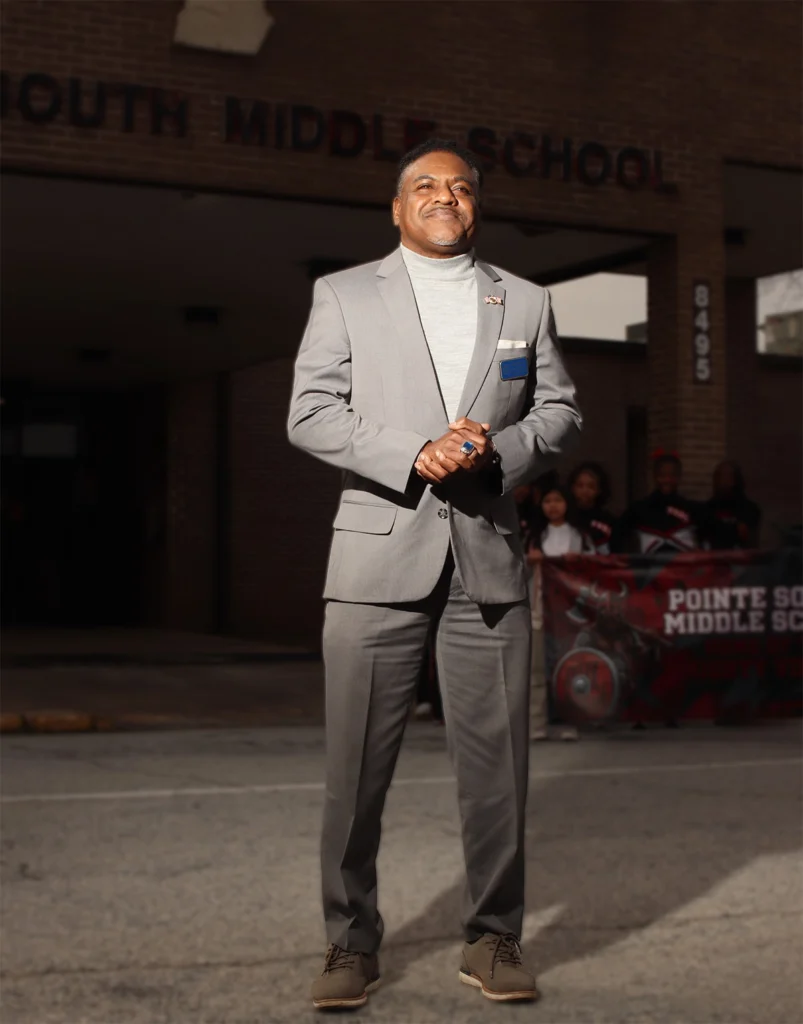
The Cost of Holding a System Together
There are leaders who arrive when momentum already exists. And then there are leaders who remain when momentum disappears — when staying costs more than leaving ever would.
As he prepares to retire from Clayton County Public Schools, the significance of his service is not captured by titles or timelines. It is measured by endurance—by what it meant to hold steady through years when the district was defined less by promise and more by pressure.
For more than three decades, Dr. Smith lived inside this system. He did not orbit it. He did not step in for the easy chapters. He taught here. He led here. He stayed—through instability, scrutiny, and long stretches when improvement felt uncertain and recognition nonexistent.
“I never flinched,” he said. “I had no desire to abandon the children or the families.”
That decision—to remain—became the quiet throughline of his leadership.
WHEN STAYING WAS THE HARDER CHOICE
To understand Dr. Smith’s impact, you have to remember the emotional climate of Clayton County Public Schools in years past. There were seasons when confidence was thin. When families carried explanations with them. When educators left for safer ground. When students absorbed narratives about their schools that had nothing to do with their potential.
“Those were very challenging times,” he said. “But my love was for the children, for the people, and for the family. I had no desire to leave or abandon them whatsoever.”
That loyalty mattered—not symbolically, but structurally. Leaders who leave during crisis never have to carry its consequences. Leaders who stay do.
Dr. Smith stayed long enough to absorb the weight of decisions, rebuild trust incrementally, and demonstrate that improvement in public education is not a single act, but a sustained practice.
A LEADER SHAPED BY PROXIMITY, NOT DISTANCE
Dr. Smith’s authority was not imported. It was earned through proximity. He taught in Clayton classrooms. He served as a principal. He worked feeder patterns that allowed him to know students and families across years, not just test cycles. He rose through central office roles before becoming superintendent.
“I have literally hit every rung on the ladder.”
That progression gave him lived credibility. He understood how policy landed in classrooms. He knew where systems failed under pressure. And he knew people—not as titles, but as professionals he had watched grow.
That grounding shaped how he approached partnerships across the county—municipal leaders, law enforcement, faith communities, business partners, and higher education institutions.
“These folks are valuable key stakeholders. It’s in my best interest—and the school system’s best interest—to have the best possible relationships with those entities.” In a county as interconnected as Clayton, that approach strengthened schools by design.

REFRAMING SUCCESS: THE 4E EFFECT
Dr. Smith recognized a truth many systems resisted: not every student’s future follows the same path—and pretending otherwise costs young people their confidence. Out of that recognition came the 4E framework, ensuring students graduated with a pathway tied to enrollment, enlistment, employment, or entrepreneurship.
“There’s absolutely no reason why any student graduating from Clayton County Public Schools shouldn’t have a pathway to success. Pick something. We’ll pour into you.” Culturally, the impact was as significant as the structure. It told students—especially those uncertain about college—that they were still visible inside the district’s vision. “You can start with one E and shift to another,” he said. “That’s life.”
THE CAPITAL TURNAROUND: NEARLY $1 BILLION AND A NEW STANDARD
For many residents, the most undeniable transformation under Dr. Smith’s leadership is physical. In March 2023, voters approved a $440 million bond referendum with 79% support. A second referendum followed, totaling $495 million—bringing nearly $1 billion in capital investment. “Truth be told, we had an old, raggedy infrastructure that was an embarrassment,” Dr. Smith said.
That reality shifted toward modernized campuses, athletic upgrades, and large-scale redevelopment—including the Convocation Center, opening in January 2026, ensuring Clayton families no longer leave the county to celebrate graduation.
“We got our own,” he said. “It’s not a bunch of talk.”
RESPECT WAS THE GOAL—AND THE RESULT
Dr. Smith never promised national ranking dominance. His commitment was more grounded. “What I can guarantee you is that we are going to be a respectable school system.”
Respect cannot be declared. It must be demonstrated—over time, without shortcuts. As the district stabilized and invested, perception followed. “People know,” he said. “They’re paying attention now.”
WHAT HIS RETIREMENT LEAVES BEHIND
Dr. Smith’s retirement marks not an ending, but a handoff.
He leaves behind infrastructure, frameworks, and momentum—but more importantly, a recalibrated sense of worth. “Keep believing in Clayton County. Keep believing in our students. Keep believing in our staff. We’re on the right track.”
He believed when belief was costly. He stayed when leaving would have been easier. And he held the system long enough for others to finally see what had always been there. Dr. Anthony W. Smith did not simply lead Clayton County Public Schools.
He held it—until it could stand on its own.