
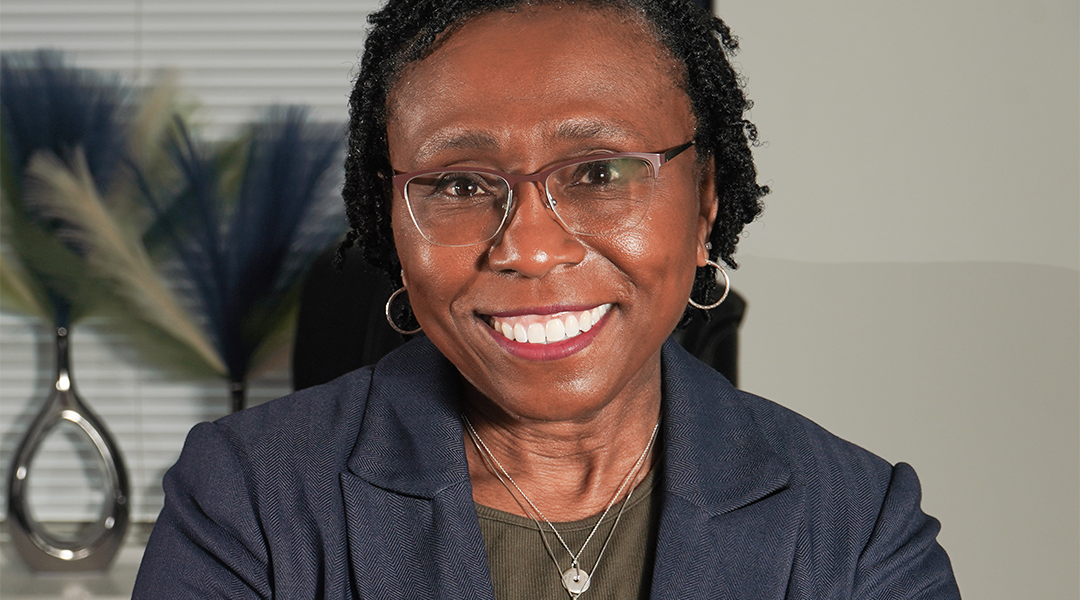
Tasha Mosley is not your typical hard-nosed District Attorney who is only looking to prosecute criminals to the fullest extent. Certainly, she is not soft on crime but rather she sees her role as a service that makes an impact on the community as a whole.
“If I choose not to accuse you, by dropping an indictment, it’s like I’m giving you a second chance. Now, do I send them to a diversion program? Do I think this person is redeemable ? Is this a person that we can keep in society and is going to be a productive member of society?” Mosley said in her office recently. “Did they just screw up or did they screw up so bad and they a have history of doing bad things that you have to put them away?”
After graduating from John Marshall Law School in 1996, she did the typical law-school grad thing by opening an office in Jonesboro. As an intern she had attended numerous corporate lawyer meetings that were incredibly boring to her. It didn’t take her long to see the corporate route was not for her. In her private practice as well, Mosley found, after only a few short months, that criminal defense was not in her future.
“I was like prosecution is where I belong. That’s where my heart felt I should go,” she said. “I want to make an impact.”
In 1998, Mosley became Assistant Solicitor General in the Clayton County Judicial Circuit and six years later she was appointed Assistant Solicitor General in Henry County as well as Master Assistant Solicitor General. Since 2009, she has been the Solicitor General for the Clayton County district.
A petite, perpetually smiling, woman, Mosley took on the DA position despite knowing its financial viability was not equal to the other judicial districts around her. For example, when she needs to hire a prosecutor or victim advocate or other legal officers, she routinely loses the best prospects to surrounding district like Fulton, DeKalb or Henry. While the state provides partial funds to pay about 17 of the DA’s staff, the rest must come from the district itself.
“My biggest challenge is keeping this place fully staffed. We cannot compete with the districts that have more money,” Mosley said, shaking her head. “I think Clayton County’s mentality is we are Mayberry, and we’re not. We have to act like a metropolitan suburb.”
The Clayton district is often compared to Covington or Troup County, where, unlike those places, the district lies beside the big Atlanta metropolitan counties. Mosley can offer a prosecutor an $84,000 a year position while in Henry or DeKalb it would be $100,000 or more.
“I just lost a great victim advocate to DeKalb county. I think we were paying her like 27 dollars an hour but DeKalb is paying her 33 to 36 dollar an hour. She came to me and asked what can you do? I said I can shake your hand and say congratulations and good luck.” Said Mosley. “And she’s a Clayton County citizen.”
From her office of 104 people, Mosley has 27 prosecutors. She said she would need at least 50 more prosecutors and five more judges to handle the current caseload in Clayton, which, believe it or not, is still suffering the effects of the Covid pandemic when only one jury trial per week could be heard.
“People were taking pleas. I pled out felony murder during that that period of time. So people were taking pleas but there’s still the vast majority who wanted jury trials. And by the time we came out of COVID, the senior judges were snatched up.”
Staff shortages keep the judicial system in Clayton clogged up, said Mosley. She gave the case of Michael White, just recently convicted of murder in a notorious 2015 slaying of two kids. Cases move slowly because the time between indictment and trial can be years, and without a full staff the process goes even slower.
According to Mosley, murders and other violent crimes have gone down the last few years. Yet, it is the constant flow of illegal drugs through Clayton County that keeps the DA’s office humming. While you may think the world’s busiest airport in the world, located here in Clayton County, would be the main conduit for drugs, Mosley said it is the I-75 corridor that is bringing in the most drugs. She despises the fact that her caseload contains so many young people accused of possessing marijuana, still a felony in Georgia.
Her most odious task, even more than prosecuting murders, held on the first Tuesday of every month, is the child fatality review, where she must look into any child deaths in the county. “It is depressing,” she understandably said.
The focus of her life changed dramatically when she attended Southern Methodist University in Dallas, Texas. Why SMU?
“It was far enough away from my parents,” said Mosley “Two of my brothers went to historically black colleges (Tuskegee and Florida A&M) and one got a scholarship to Mercer. My mother used to drop in all the time. She would say, ‘We’re going to visit your brothers.’ No warning.”
So when SMU gave her some scholarship money, off to Texas she went to follow her dream of being a cardiologist. It didn’t take long, however, for Mosley to discover that biology and chemistry were not what she expected. “Do I really want a lifetime of this ,and the answer was a hard no,” said Mosley, who switched to Economics and Political Science, which would eventually lead her to law school.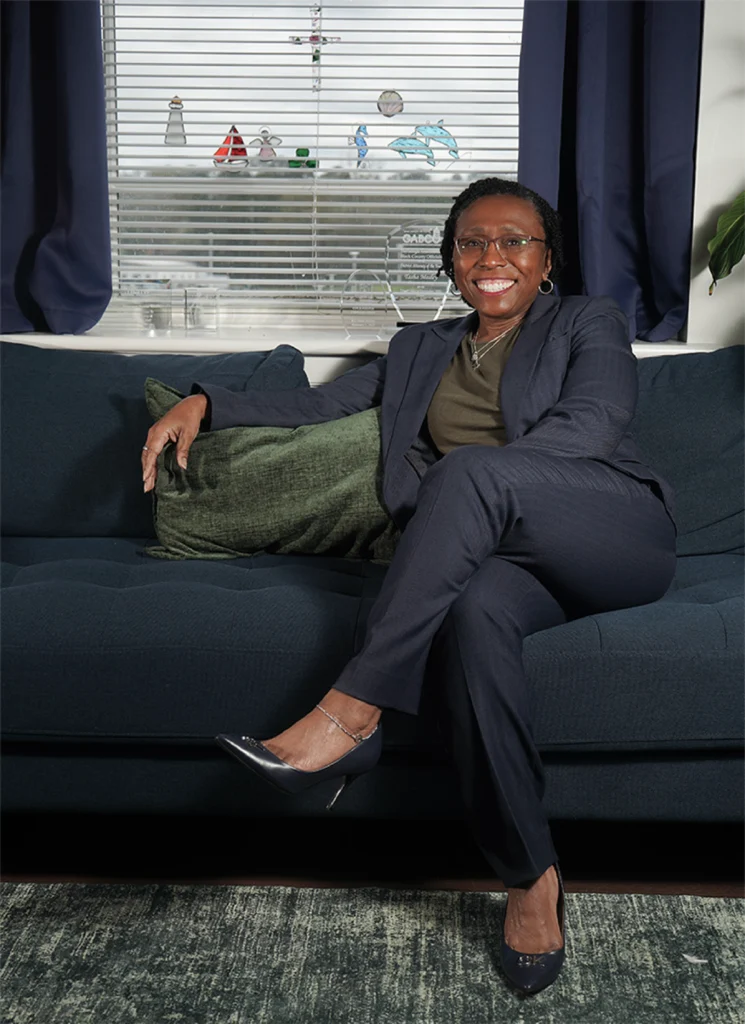
An equally life changing effect on her occurred during a protest against the university’s financial interests with the apartheid South African government that would soon fall. Mosley joined fellow students in erecting a shanty town in front of the biggest hall on campus. They even made it fireproof to sure it would stand up to an inspection by the Fire Marshall. SMU finally acceded to divesting all its investments in South Africa. It would lead her to an on-going commitment to making an impact on her local community.
“I think that’s that was the beginning of it for me. It was, ‘OK, this is the route I’m going down.’ I felt that I had made an impact,” she said.
Over the years she has volunteered for charity groups such as the Calvary Refuge Center and the Rainbow House in addition to a slew of professional organizations such as the Prosecuting Attorneys Council of Georgia (PAC), State Bar of Georgia’s Judicial Evaluation Committee, the Clayton County Bar Association, and the Solicitor General Association of Georgia (SGA).
“Heck, I was everything. When I was Solicitor, I was secretary vice president. I have been on the executive board council of PAC for, I don’t know how many times. I was secretary of the DA’s association ,vice president, ex officio vice president, and chairwoman of the executive board of the prosecuting attorneys council for a couple of years,” she said. “I’ll be happy to turn it over to those that are younger and have way more energy than me right now.”
Her tireless work has garnered her a number of professional awards, including the 2013 Clayton County Bar Association Community Service Award, 2015 and 2018 Freddie L. Groomes-McClendon Caring Awards, 2018 Angela M. Williams Humanitarian Award, 2018 Regina Crothers from the Heart Award, and 2018 Thompson-Jones Award, among others.
She has had to cut back on her time spent with charities and professional organizations for the most part because of her self-proclaimed first job as caregiver to her 90-year old mother, who is afflicted with Alzheimer’s. From the time she arrives home to when her mom eventually goes to bed, Mosley is interacting with her mother as much as she can. They read Bible verses together and attend church services via streaming.
“My brain wakes up at about 4:45 and by about 5:30 I am up and out of my bed. I get myself together to make sure that I get her up and get her ready. My number one job is caretaker, then I come to job number two as DA,” said Mosley. “I either get home a little bit after five or I might get home later in the evening, and then I’m back on job number one until I get her to sleep and I go to sleep. I tell the dog you’re going to sleep, too.”
She said that after her time as District Attorney is over, the next logical step would be to become a judge. Not for Mosley.
“Hopefully, Clayton County will allow me to leave on my own terms. Whatever I do with the last years of my life, I know it’s going to still be public service. It’s going to be something where I’m giving back to the community,” she said. “I think that’s what God wants me to do. You’re supposed to give back to your community, give back to the world and make the world a better place. So that’s ultimately what I what I want to do. I just don’t know how that’s going to look.”